
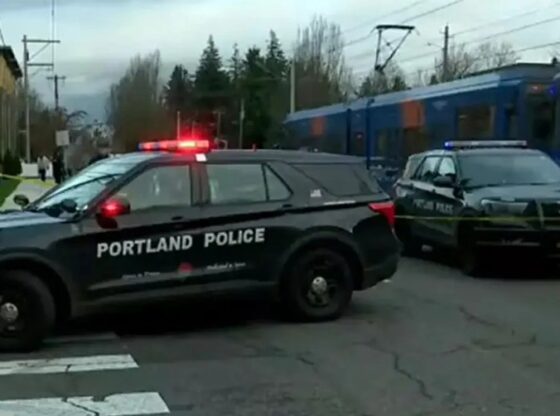

TWO people have been shot by U.S Customs and Border Protection cops in Portland.
A man and woman were reportedly rushed to hospital with gunshot wounds after the altercation with federal agents.

It comes just a day after 37-year-old Renee Good was shot and killed by an Immigration and Customs Enforcement agent in Minneapolis.
Police are said to have applied a tourniquet to one of the victims before emergency responders arrived.
Portland Chief Bob Day said: “We are still in the early stages of this incident.
“We understand the heightened emotion and tension many are feeling in the wake of the shooting in Minneapolis, but I am asking the community to remain calm as we work to learn more.”

CITY ON EDGE
Protests rage in Minneapolis forcing school closures after fatal ICE shooting
The Portland Police Bureau said that its officers were not involved in the shooting.
It wrote: “At 2.24pm, officers received information that a man who had been shot was calling and requesting help in the area of Northeast 146th Avenue and East Burnside.
“Officers responded and found a male and female with apparent gunshot wounds.
“The patients were transported to the hospital. Their conditions are unknown.”
Portland’s mayor, Keith Wilson, confirmed the shooting in a statement, writing: “Just one day after the horrific violence in Minnesota at the hands of federal agents, our community here in Portland is now grappling with another deeply troubling incident.”
Fiery clashes have broken out across Minneapolis after the fatal ICE protestor shooting, forcing schools and stores to shut down.
Armed, masked officers with apparent Border Patrol insignia were seen detaining individuals on a sidewalk outside the school as bystanders shouted and blew whistles.
Officers tackled people, used pepper spray and pepper balls, and handcuffed two school staff members, witnesses told MPR news.
Early Thursday, dozens of protesters also gathered outside a federal building on the edge of Minneapolis that is serving as a major base for the immigration crackdown.
Demonstrators on the streets are protesting against the claim that an ICE agent acted in self-defense when he shot and killed Good when they say she tried to run him over.
Harrowing videos have captured the full scope of the tense confrontation that led to the deadly shooting.
The newest angle appears to show Good striking an agent with her SUV, leading him to fire three fatal shots at the intersection of a quiet residential Minneapolis neighbourhood.
The newest video of Wednesday’s incident, apparently taken from a nearby balcony, offers a wide-angle view of the encounter from in front of the vehicle.
In the video, which is lower quality than other available angles, the agent appears to lurch backward as the Honda SUV accelerates forward and as he fires the three shots.
The clip captures the car accelerating out of control and smashing into another vehicle parked on the street after the driver was shot.
rump and other federal authorities have insisted the video is crystal clear proof that Good was attempting to block federal agents in an act they deemed “domestic terrorism.”
Department of Homeland Security spokesperson Tricia McLaughlin claimed Good, “weaponized her vehicle, attempting to run over our law enforcement officers in an attempt to kill them.”
Trump said the videos were a “horrible thing to watch” and stressed that the agent’s life was at risk.