

This is controversial, but, until a few days ago, I considered electronic music to be limited to sounds generated by a machine that could then be manipulated to be presented, regardless of the context. In this equation, in my head, the harmonics of acoustic instruments, the frequencies that make them unique, were excluded. For this reason, I built walls around electronic music, assuming that I didn’t like it, without understanding it. I didn’t like it, I thought it was artificial and far from the baroque geniuses. Part of this observation is true, in the sense that there are machines involved in the process, but there is an intentionality on the part of those who manipulate the sounds, and, at the limit, there is even the specificity of the room where the sounds are presented. This is the story of the moment I sat in seat K-14, at the Emílio Rui Vilar Auditorium, at Culturgest, in Lisbon, and went through an alchemical ritual of death and resurrection with regard to electronic music.
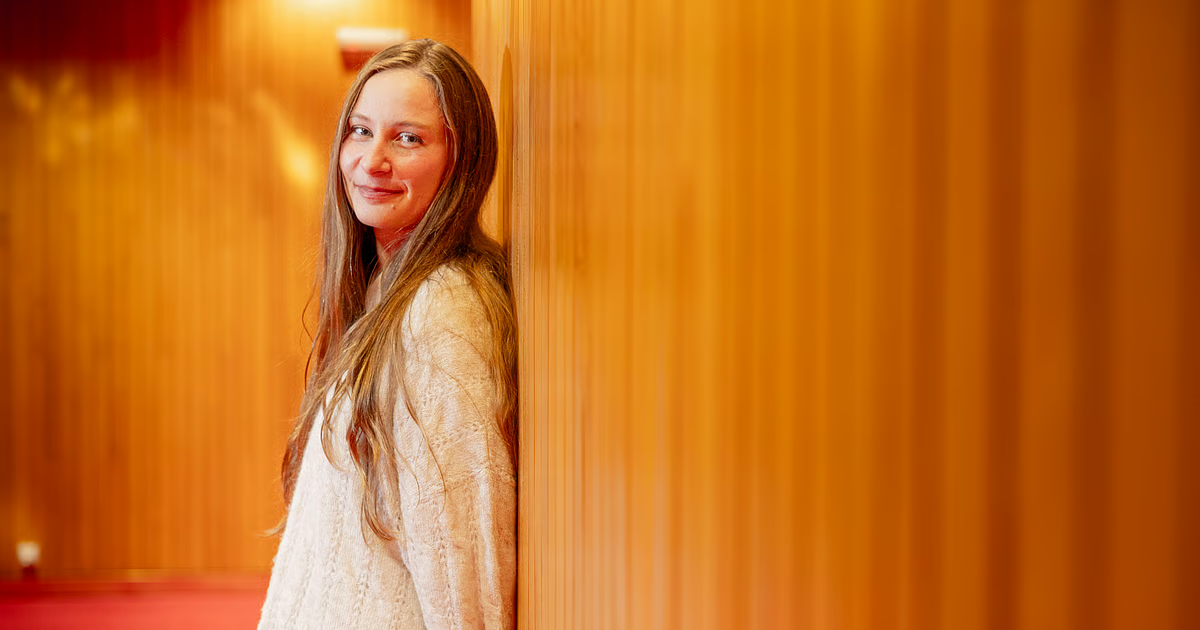
The person responsible for my transformation is the Canadian composer Kara-Lis Coverdale, who intentionally carries with her an ancestral tradition of Estonian music, taking into account her family ancestry (because all of us, as we are not trees, have roots that do not correspond to the place where we are). Her show promised to be partly electronic music. What was left was acoustic music, on a piano. The stage did not disappoint. In the middle, facing the audience, was a relatively small table, with a computer and some devices connected to it. On the right side of the stage, from the audience’s perspective, was a black acoustic piano, which did not blend into the simple, dark setting of the auditorium.
The artist enters the stage, is applauded, waves humbly, sits at the table where the computer is and, without hesitation, opens the dam turbine that contained the music she had prepared. Invade us all with music from two albums: From Where You Came and A Series of Actions in a Sphere of Forever, both from 2025.
Because I had the privilege of speaking with the artist before the concert, I knew that, according to what she had told me, it would be “unpredictable” and “sacred” music. These are two terms that I wouldn’t associate with electronic music, but then I realized.
Kara-Lis Coverdale, among many things she does with music, is the resident organist at the Evangelical Lutheran Church Saint John, in Montreal, Canada. She admits her passion for pipe organs, which are clearly musical instruments that leave no one indifferent. Perhaps this is the most visible sacred part of all the music he makes.
But let’s get back to the whirlwind. In the electronic music that led to Culturgest, there were samples of pipe organs, there were intelligible voices, which maybe weren’t voices at all, there were sounds that I didn’t know existed. She gestured. Her body was part of the music, it was all a kind of choreographic appeal to the listener. The diffused light helped everything to propagate.
There is another dimension to Kara-Lis Coverdale’s music that she warned me about: it involves critical thinking and is not to be listened to with the “brain turned off”. This also applies to the acoustic part of the concert.
The “sacred music” continued and I remained invaded by it. I didn’t understand the beginning or the end, and I can’t hum any specific melody I heard that night, but the sensations remained. It was a ritual.
There was no interruption. The programmed electronic sounds continued autonomously as Kara-Lis Coverdale stood up. He walked less than two meters to the piano. She remained static in front of the keyboard while the computer very slowly finished what it was doing. A few minutes later, silence. The artist lifted one of her hands, delicately, and let it solemnly fall onto the keyboard, like an oak leaf. The “sacred music” continued, but without electronic mediation. The whirlwind was different, but with all the senses on alert, so that the music was not made up of moments, despite it being.
There is a before and after all this. I realized that there is a place in my life for electronic music and I realized that I had unconsciously fought against an aesthetic inevitability. I don’t like baroque music any less because I discovered that there are other musical rituals, but I shouldn’t have spent so much time putting barbed wire around something that didn’t make sense to me. In the end, I only remembered a verse from the poem Rhapsody on a Windy Night, by TS Eliot, about the uselessness of some gestures, which, in a free translation from English, is more or less this: “Midnight shakes the memory like a madman shakes a dead geranium.”