
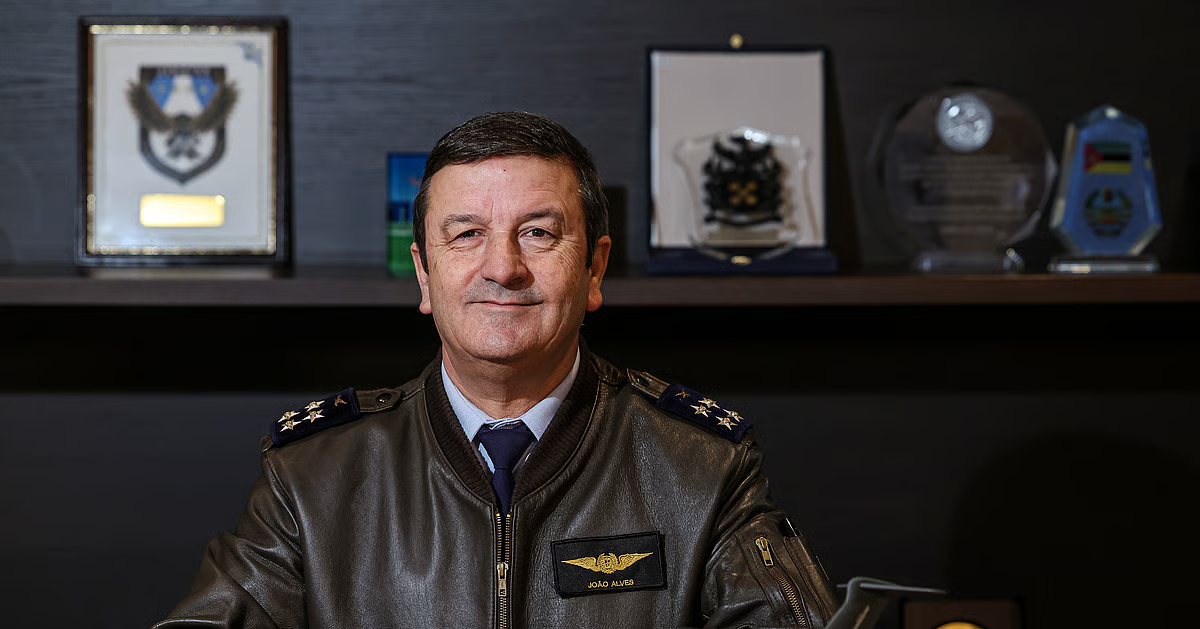

But when is the ideal time for a decision to be made? How much longer can the F-16 last?
This is not a question of “putting up with it”. It has to do with the evolution of systems and the obsoleteness of some current capabilities. I am convinced that this decision will take place over the next year. At the moment, we are working in parallel in both dimensions — the fifth and sixth generation — because, historically, the Air Force has always operated with two air defense aircraft simultaneously, which is normal in practically all countries.
We have had a delay in the past, but we are finally getting into the right rhythms. I am convinced that, over the next year, we will have news about replacing the F-16s.
It has monitored the positioning of the market and the industry, particularly European competition from North American manufacturers. You, General, have already publicly stated that the F-35 would be the most natural choice. Taking into account that, in the SAFE program, the minister highlighted that the choices were technical and not political, does this make you feel more at ease about the decision that will be taken?
Of course. Let’s see: it is up to a branch, a military force, to identify the best option from a strictly military point of view. As the Anglo-Saxons say, the best military option. It is up to the Air Force to say what the best military solution is for a given capability. Naturally, it is then up to the political power to make the final decision, weighing advantages, disadvantages and risks, and deciding whether or not to proceed along this path.
I think there is a convergence of ideas here between different areas. As I have already mentioned, this process did not begin at the right time in the past and, therefore, it must now be framed at the appropriate time, in conjunction with other systems and other capabilities that give meaning to this option.
We are well aware of the very strong positioning of most countries. But we also have to consider factors such as delivery times, whether for fifth generation or sixth generation aircraft. These options are not incompatible with each other. If Portugal does things correctly, we could have fifth generation and, later, sixth generation aircraft starting to operate within this time horizon.
We cannot look at these decisions from an immediate perspective. We always have to think 20 years ahead. Air Force systems are highly technological and force us to be visionary, to look ahead. The sixth generation, for example, already incorporates directed energy systems. We are no longer just talking about aircraft that launch missiles, but about completely disruptive technologies. We have to think about them today — and we already have people working in these areas.
This means that there is an intermediate path to follow and that the essential thing is the training of forces. Portugal is often seen only in its territorial dimension from north to south, but the strategic reality is different. The distance between the border west of the Azores, beyond Flores, and the land border with Spain is similar to the distance between Lisbon and Ukraine.
If we look at the European space, at the number of systems and aircraft that operate there, we realize that we have to design the Air Force and the Armed Forces to respond to future conflicts, which tend to be increasingly regional. We started with Ukraine in 2022, we have Israel, conflicts in Mali, the Central African Republic, tensions in the South China Sea between China and the Philippines, and the Taiwan issue between the United States and China.
All of this is interconnected. Portugal is at the crossroads of the largest air and sea lines of communication between the United States, South America and Europe. Our strategic area is at the center of these routes and, therefore, we have to size our forces in order to guarantee capacity for action and an active presence in what is, first and foremost, national sovereignty.