
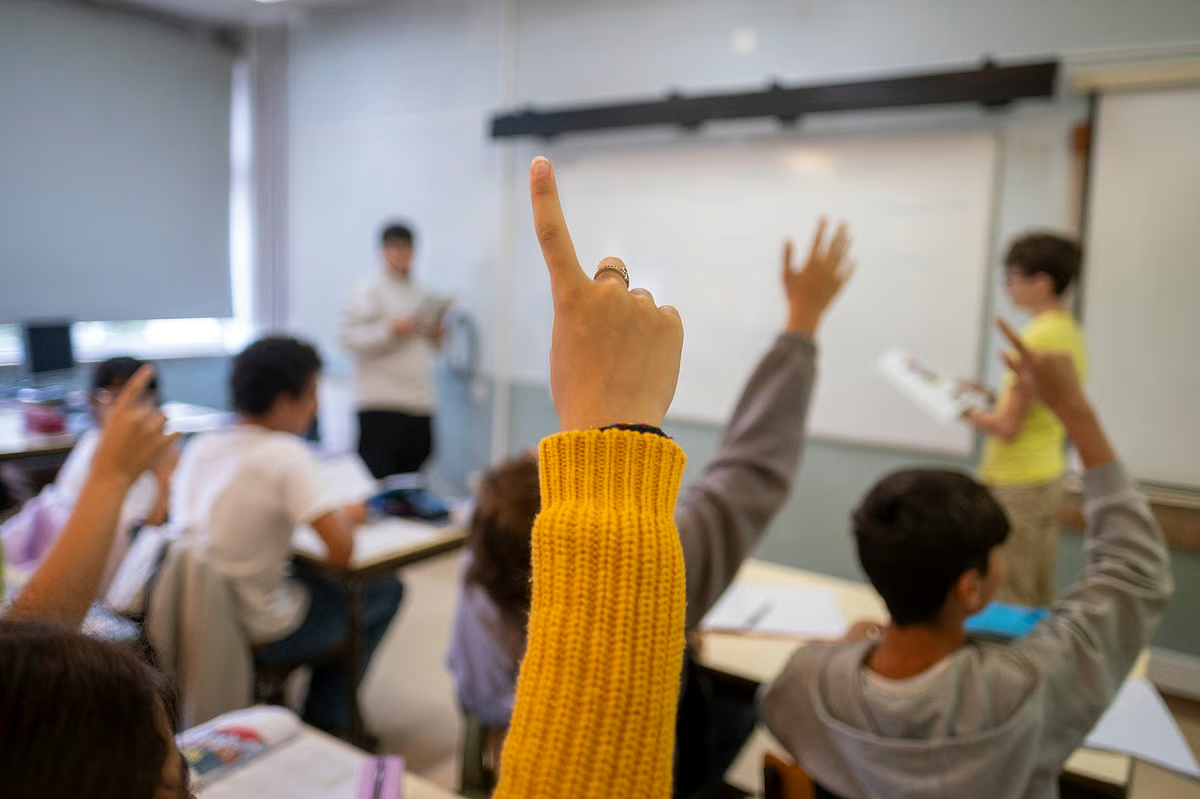

“My daughter is 13 years old, goes to a public school in Lisbon and tells me that her classmates, especially the boys, sing ‘Chega, Chega’ and the song ‘This is not Bangladesh’ at recess.”
The information comes from a 43-year-old woman whose identity DN intends to hide. Her daughter’s class, she informs, has many children of immigrants, several of them of Indonesian origin. These are not the ones who sing the song in question, in which the chorus is heard, rhyming with Bangladesh, “get your brown kids out of my daycare”.
Created by a youtuber and published in a video made using Artificial Intelligence, allegedly with the aim of satirizing the xenophobic and racist speech of André Ventura and Chega (in reference to the mention, by the leader and a deputy of the party, of names of children allegedly enrolled in a Lisbon kindergarten, to “prove” these are “zero Portuguese” children which would take precedence over “national” onesa mention that was subject of a letter of rejection from six parents’ associationsfrom a criminal complaint and a civil case), the song was appropriated by the party, which placed the title on a poster (an act that was also the subject of legal action).
If we believe the reports that this 8th grade student tells her mother, the children targeted by the singing (that is, those from Bangladesh) do not react: “Either they ignore it or, if they don’t ignore it, they don’t make any kind of complaint.” On the contrary, Sofia’s daughter — let’s call her that — made her family aware of her discomfort. The mother thinks this sensitivity is partly due to the fact that they themselves were immigrants to the United Kingdom. “We were in the north of the country for seven years, and When we lived there it was my daughter, as the only Portuguese, the ‘different’ girl. She told us that she wanted to be blonde and blue-eyed, she wanted to be like other children. So I think she feels this in a more personal way.”
The girl’s awareness will also come, the mother believes, from at home, at dinner time, when the family gets together, “often talking about these issues of discrimination and systemic racism”. Conversations that, Sofia assumes, will not occur in the families of the kids who star in the aforementioned songs, and who her daughter describes as “non-immigrants”. “They are a bit like parrots at these ages, they repeat a lot of what they hear”, he reflects. “And the school doesn’t do anything about it.”
“They know Chega more than anything else”
It won’t be like that. Or rather, it depends. Depending on Rita (not her name either), 25 years old, secondary economics teacher in Greater Lisbon, things are not clear. “The other day, in a class that was behaving particularly badly, they started singing ‘This is not Bangladesh’ during class. I expressed my displeasure and they wanted to know why. I told them about the immigrant courier who was murdered [Shamin Bhai, de 32 anos, natural do Bangladesh, mortalmente esfaqueado a 28 de setembro na Costa da Caparica, quando tentava recuperar a sua bicicleta, que lhe fora furtada]. They were silent for a while but then some people asked ‘so what was he doing?’”
Rita has a bitter smile in her voice. “In another class we were talking about financial literacy and some students asked ‘Do you know what they’re doing? André Ventura talked about this, immigrants are taking things away from Social Security’. I asked ‘What are they taking?’, they replied: ‘They are taking money.’ When I asked how they got the money, they couldn’t answer me, because they didn’t even understand what they were talking about. These kids don’t watch debates, they don’t watch TV, they don’t watch the news. They see 10-second things taken out of context on TikTok. And they have a great tendency to say that it’s all corruption, that it’s all stealing.”
However, Rita notes, this is not about pre-teens, as in the case of Sofia’s daughter’s school, but about young people in the 12th year, some already old enough to vote. “They have a very open conversation with me, they say what they see, who they follow. And they know Chega more than anyone else. It takes them much longer to say the name of the prime minister than the name of Chega’s leader. For them it’s all a game, they’re a bit childish, they’re not aware that these things have a political nature.”
In fact, this teacher reports, there are young immigrants who support this discourse. “I have many students whose parents come from the PALOP, and one of those who said that immigrants are taking money from Social Security is an immigrant or the son of immigrants. Of course, I didn’t draw his attention to that, but I thought about it.”
How do you deal with this? “I am as impartial as possible, as I should be”, replies Rita. “I try to teach critical thinking, give information.”
“Gypsies are not from Portugal”
Sofia and Rita’s testimonies emerged following the news about the attack, at a school in the district of Viseu, on a 10-year-old Brazilian child, who lost part of the fingers on one hand, trapped by classmates in the bathroom door.
The tragedy, remember, occurred on November 10th and, given the nationality of the victim and the climate of hostility against immigrants from certain origins (including Brazil, the country from which the majority of immigration to Portugal comes from) that has been fueled by certain political discourses, the suspicion that it could have been motivated by discrimination.
A suspicion that the mother, Nivia Estevam, would deepen, narrating previous episodes: on November 5th, she told the media, her son had appeared at home with a scar on his neck, having said that a colleague had pulled his hair and kicked him; Before that, he had already commented that the way he spoke Portuguese (with a Brazilian accent) was often pointed out to him by other boys, who would complain about not understanding him.
For now, there is no official version of the reasons for the incident: the case is being investigated by the authorities and is the subject of an internal investigation at the school. But Nivia guarantees that her previous warnings, referring to the aforementioned episodes, were ignored. And that on the very day his son had his fingers mutilated They told him at school that it was “a joke gone wrong”not even warning her right away that the boy, who when his mother arrived had his hand tied up, had lost part of it (it was, she says, a firefighter who, in the ambulance to the hospital, gave her his son’s severed fingers).
In light of these reports from Nivia, on Instagram and Twitter/X, publications bearing witness to situations of discrimination carried out by both students and teachers, as well as the enthusiasm of children and adolescents with the far-right party and its anti-immigrant slogans and speech.
Publications that, in turn, sparked comments like this “mother of three”, found on @volksvargas’ Instagram account: “The older ones (13 and 11 years old) tell chilling stories about their classmates shouting ‘Enough’ in the middle of classes and walking through the corridors singing ‘Ventura owns this shit!’. The youngest, five years old, came home yesterday saying that a friend in class had said that gypsies were not from Portugal. We very calmly explained that the gypsies are actually from Portugal and that even if they weren’t, it doesn’t matter. It’s important to be human. This scares me a lot.”
Another, identified as “mother of a 10th grade student, aged 14”, corroborates: “It’s true, kids repeat Chega’s xenophobic phrases and shout ‘Chegaaaa’ for everything and anything.”
In the same place, a school employee in Tavira asserts that “This is not Bangladesh” is the most sung song, and an 8th grade Visual Education teacher comments: “The number of kids I heard singing the chorus of the song in different classes is scary”.
“If you don’t understand the question, go to your homeland”
These are, allegedly, citizens concerned about what they see as a spread of slogans and xenophobic and racist ideas among younger people — which, in cited letter from associations of parents and guardians in reaction to the use of children’s names by Chegais called a “hate narrative” — and which DN tried to listen to, managing to speak to several people (others did not respond to the newspaper’s contact requests).
Among those who responded, in addition to the aforementioned Sofia and Rita, is Maria (another fictitious name), 48 years old, with a 13-year-old son in the 8th year at Pedro Nunes secondary school, in Lisbon. He told him that In a Mathematics class, the teacher replied “if you don’t understand the question, go to your homeland” to a student whose mother tongue is not Portuguese.
The classmates, says Maria, immediately protested and complained to the management, as well as to their parents, who asked the class director for explanations. The DN contacted the school, identifying the teacher and asking if the reported facts were confirmed. The newspaper also wanted to know what procedures, if any, were adopted. The first response, signed by the director, thanked the newspaper for its interest but was not very enlightening: “At this moment we are trying to find out what actually happened in the classroom, although at the time of your contact we were already monitoring the situation”. The DN insisted and the school, this time in an email signed by the entire management, certified that “all stakeholders were heard and the situation was contextualized. Furthermore: there has not been/verifies, to date, any formal complaint made to the services of Escola Secundária Pedro Nunes”.
In the response, there is no clarification on what the “contextualization of the situation” means, nor the confirmation or refutation, which the newspaper requested from the beginning, of the facts reported, or any position on them.
Maria doesn’t even want to believe it. “If there was no complaint, how did the participants hear? Did they guess what happened in the class? What does the management consider a complaint? Is it a report to the General Inspectorate of Education and Science? If that’s what they want, they’ll have it.” Sigh. “What a story. Still, What encouraged me was the general indignation of the kids. Because it’s rare to happen.”
Teresa, 41 years old, a 3rd year teacher at a school in Greater Lisbon, believes, like the other teacher interviewed by DN, that only those who give up are defeated. And she doesn’t give up trying for her students to learn to distinguish between right and wrong — between evaluating each person based on what they do and say or deciding that there are groups of people, defined by origin, color, ethnicity, nationality, or other identity characteristic, who deserve, from the outset, animosity and discrimination. So when, in October, he caught one of them, on his way back from recess, chanting “this is not Bangladesh” amidst the laughter of some, he told them to stop. “On top of that, I have a Bangladeshi girl in that class. She stood for a while, I don’t know if she was taking in the situation.. But I think that afterwards, I think that because of the way I handled the matter, it was taken as a bad joke, with no other intention.”