
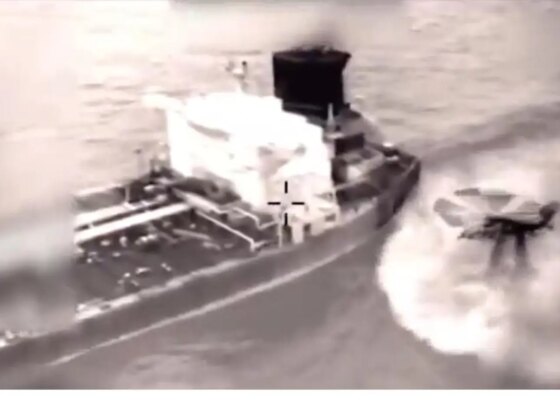

The United States Coast Guard intercepted an oil tanker in Caribbean waters near Trinidad this Friday, according to an announcement The New York Times.
It is the fifth vessel boarded as part of Washington’s efforts to control Venezuela’s oil exports.
The intercepted tanker, called Olina, which according to the public maritime transport database Equasis falsely flew the flag of Timor Leste, now changed to the Russian one, and belongs to the so-called ‘shadow fleet’.
The world’s criminals are on notice.
Early this morning, the @USCG executed a boarding and seizure of the Motor Tanker Olina in international waters east of the Caribbean Sea. As another “ghost fleet” tanker ship suspected of carrying embargoed oil, this vessel had departed… pic.twitter.com/vvS3u3nrvl
— Secretary Kristi Noem (@Sec_Noem) January 9, 2026
The Olina left Venezuela last week fully loaded with oil as part of a flotilla, shortly after the US captured Venezuelan President Nicolás Maduro on January 3, and the ship was returning fully loaded to Venezuela following the US blockade of Venezuelan oil exports.
The US imposed sanctions on the Olina in January last year, when it was christened Minerva M, for which Washington said it was part of the so-called shadow fleet of ships that sail with little known regulation or insurance.
The M Sophia, another of the tankers that was part of a flotilla of a dozen vessels that left Venezuela earlier this month, was seized by US forces earlier this week.
Three ships – Skylyn, Min Hang and Merope – all fully loaded and part of the same flotilla that departed last week, sailed back to Venezuelan waters on Thursday, according to the industry source.
Last Wednesday, the US launched another military operation that resulted in the capture of two more oil tankers. The first intercepted was the Marinera, with the Russian flag, which was sailing through the North Atlantic.
The second operation was carried out in Latin American waters. In this case it was the M Sophia, a Panamanian supertanker, sanctioned by the United States and part of the so-called shadow fleet that transports Venezuelan crude oil to China with the transponder turned off.
M Sophia was sailing under the flag, that is, displaying the Cameroonian flag, despite being registered under Panama.
The operation against the Russian-flagged oil tanker Marinera, which was sailing in the waters of the North Atlantic, occurred after two weeks of pursuit. The move came after Moscow decided to mobilize a submarine to protect the ship.
On December 10, Washington seized the sanctioned ship Skipper and confiscated the crude oil it was transporting.
Days later, Trump ordered a total blockade of the entry and exit of this country to oil tankers sanctioned by the US Government, within the pressure he exerts on the Maduro Government, which Washington accuses of leading a drug trafficking network.
On December 20, the United States intercepted another Panama-flagged oil tanker in international waters of the Caribbean, off the coast of Venezuela. It was the Centuries and was not part of the list of oil tankers sanctioned by Washington.
The ‘shadow fleet’
The call ‘fleet ghost‘ o ‘floats in the shadows’ of Russia is a network made up of hundreds of old oil tankers, with insurance and front companies outside Western circuits, used to continue exporting crude oil dodging the sanctions imposed by the war in Ukraine.
Many of these vessels turn off their tracking systems, manipulate data and make ship-to-ship transfers to hide the origin of the oil, which often ends up in refineries in Asia and returns to the global market under another label.
This framework allows Moscow to maintain key energy revenues to finance its war effortalthough selling at a discount and assuming increasing risks of accidents and pollution.
The United States considers this ‘shadow fleet’ to be a central element of Russia’s ability to sustain its economy and its war in Ukraine, which is why it has made it a priority target of its sanctions policy.
He The Treasury Department has specifically sanctioned dozens of companies and more than a hundred oil tankers. linked to this circuit, raising the legal and financial risk for any actor who helps transport or secure Russian crude oil above the G7 price cap.
Washington combines these financial measures with attempts to seize sanctioned vessels on the high seas when they transport Russian, Iranian or Venezuelan oil, which has raised tensions with Moscow.
The official US position is presented as a strategy to “reduce the Kremlin’s energy revenues without destabilizing the world oil market”, insisting that the goal is war revenues and not a total embargo on Russian crude oil.
However, this pursuit of tankers from the ‘ghost fleet’ and the boarding or seizure plans have caused diplomatic clashes with Russiawhich accuses Washington of violating freedom of navigation and militarizing energy trade.
At the same time, The US coordinates its approach with the European Union and the G7which are tightening their own sanctions packages and lists of ships designated as part of the Russian ‘ghost fleet’.