
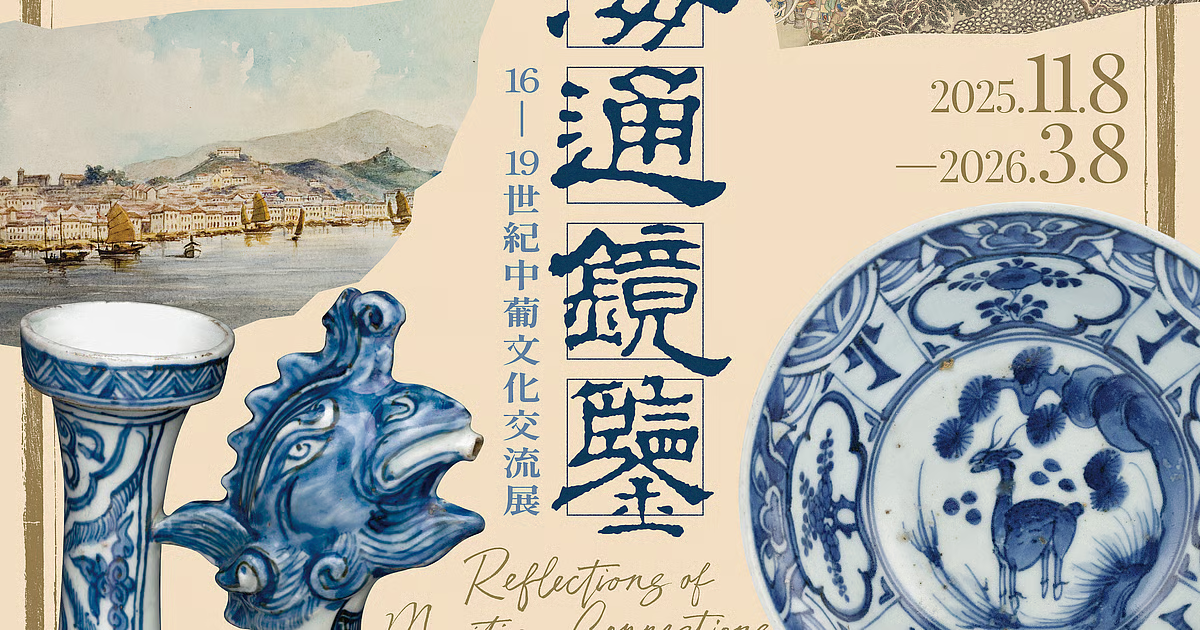

The exhibition brings together a total of 177 pieces (or sets) from the Palace Museum, Portuguese museum institutions and the Macao SAR Cultural Institute, presenting the path of the Sino-Portuguese cultural exchange that took place between the 16th and 19th centuries through the Maritime Silk Road – from popular commerce to official relations – highlighting Macau’s unique role as a platform for confluence between Eastern and Western cultures.
The exhibition is structured into three thematic sections – “Dawn of the Porcelain Route”, “Cultural Exchange in Porcelain” and “Dialogues between Cortes” – selecting representative pieces belonging to cultural institutions in China and Portugal.
The theme “Reflections of Maritime Connections” symbolizes not only the abundant material legacy that the Maritime Silk Road left, but also the spark of dialogue and mutual learning between civilizations that took place through Macau as a “cultural window”.
The first thematic nucleus – “Dawn of the Porcelain Route” – goes back to 1498, when the Portuguese fleet led by Vasco da Gama rounded the Cape of Good Hope and reached Calicut, in India, marking the official opening of the new sea route to the East.
In 1510, the Portuguese occupied Goa and, the following year, Malacca, arriving in 1513 on the coasts of Guangdong, China, where they began trading between China and Southeast Asia. As they were unable to establish official diplomatic relations with the Ming dynasty, the Portuguese ended up abandoning the waters of Guangdong, looking for new opportunities along the coasts of Fujian and Zhejiang. At this stage, Chinese porcelain – especially blue and white ware from Jingdezhen, in Jiangxi province – became a collectible for European courts and aristocracies. The establishment of the Sino-Portuguese ceramic trade paved the way for the systematic entry of Chinese porcelain into the European market and contributed to the development of European custom porcelain production.
Between the end of the Ming dynasty and the beginning of the Qing dynasty (1628-1700), military conflicts partially interrupted international trade in Macau. However, during the reign of Kangxi (1654-1722), and with the establishment of diplomatic relations between the Chinese and Portuguese courts, trade resumed, allowing Macau to continue to play the role of a strategic node in global trade networks, expanding the export of Chinese porcelain to different parts of the world.
At the end of the 19th century, the Portuguese occupied Macau and established colonial administration in the territory, but, with the development of Hong Kong as a strategic port for China’s coastal maritime trade, Macau would gradually lose its status as the main trading post in the region.
The second nucleus – “Cultural Exchange in Porcelain” – addresses the artistic fusion between East and West in the field of ceramic production. According to historical records, in Europe at the time there was great enthusiasm for creating pieces that incorporated Chinese aesthetic elements, while Chinese ceramic production, in turn, introduced innovations adapted to the demand of the European market.