
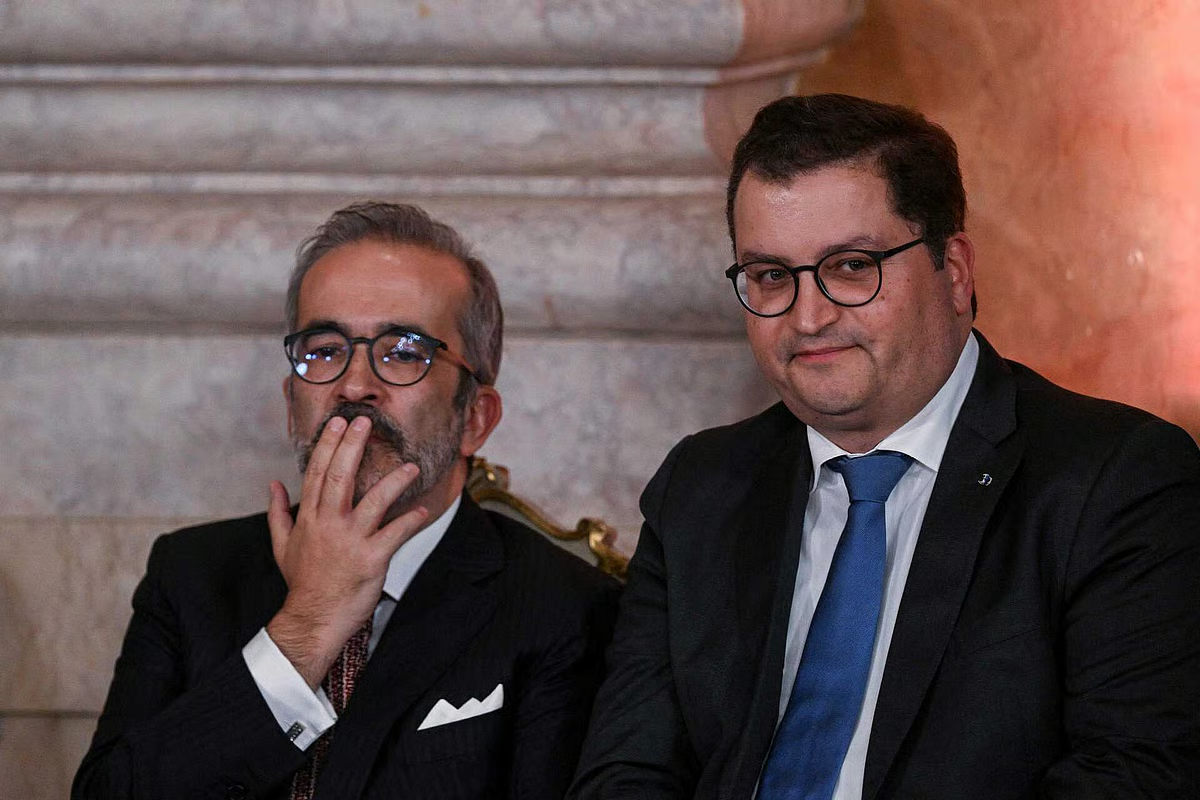

The Ministers of Foreign Affairs and Finance and the Mayor of Porto present today, in Brussels, the Portuguese candidacy to host the headquarters of the European Customs Authority, with eight other countries competing.
In an event taking place this Tuesday, 2nd, at Portugal’s permanent representation at the European Union (EU), the ministers of Foreign Affairs, Paulo Rangel, and of Finance, Joaquim Miranda Sarmento, and the mayor of Porto, Pedro Duarte, will present the Portuguese candidacy for the European Customs Authority (EUCA).
This is the official presentation in Brussels – after the candidacy has been formalized with the European Commission – to an audience made up of members of the European institutions.
It is now up to the community executive to evaluate and issue an opinion, in a decision that will be taken by co-legislators (countries and MEPs), perhaps in February.
The EU Customs Authority is a new community agency, proposed by the European Commission in 2023, which will have the task of coordinating the management of customs risks between the different customs administrations of the EU Member States.
In addition to Portugal, eight other countries are competing: Belgium (Liège), Spain (Málaga), France (Lille), Croatia (Zagreb), Italy (Rome), Netherlands (The Hague), Poland (Warsaw) and Romania (Bucharest).
Last September, the Portuguese Government announced that it would present a European candidacy to host the new European Union Customs Authority in Portugal, in Porto.
The executive announced at the time, through a statement released by the Ministry of Finance, that he would “proceed with an application for the selection process” as he considered that “Portugal meets the necessary conditions to ensure the facilities of this new entity”.
For the Portuguese Government, the country’s geographic location is one of the advantages of the candidacy.
“The country is the natural gateway for transatlantic and intercontinental trade in Europe, with an extensive maritime border, and a great tradition in customs matters”, argued the Ministry of Finance at the time.
The “history of innovation, particularly in digitalization” of the Portuguese Tax and Customs Authority was indicated as another reason.
Regarding the choice of Porto as a candidate city to locate the agency, the guardianship explained that, taking into account the selection criteria, the city is the “most suitable, ensuring good accessibility and infrastructure, conditions of access to the job market and education, safety and quality of life”.
However, the exact location was not mentioned.
The EU Customs Authority must be established from 2026, with the European Commission being responsible for starting operations.
Portugal’s idea would be that, from next year, the headquarters would be in operation so that, in 2034, around 250 employees would work at the facilities.
The community executive will now evaluate the nine applications over the next few weeks, wanting to ensure that the location will allow the authority to carry out its tasks and powers, recruit highly qualified and specialized staff and offer training opportunities.
Brussels will also check the accessibility of the location, the existence of social facilities, adequate access to social security and medical care and also the geographical balance.
Currently, there are two decentralized EU agencies based in Portugal, more precisely in Lisbon, namely the European Maritime Safety Agency and the European Union Agency on Drugs.
Portugal even unsuccessfully competed for the European Medicines Agency with Lisbon and Porto.
The EU has more than 30 decentralized agencies spread across several Member States.