
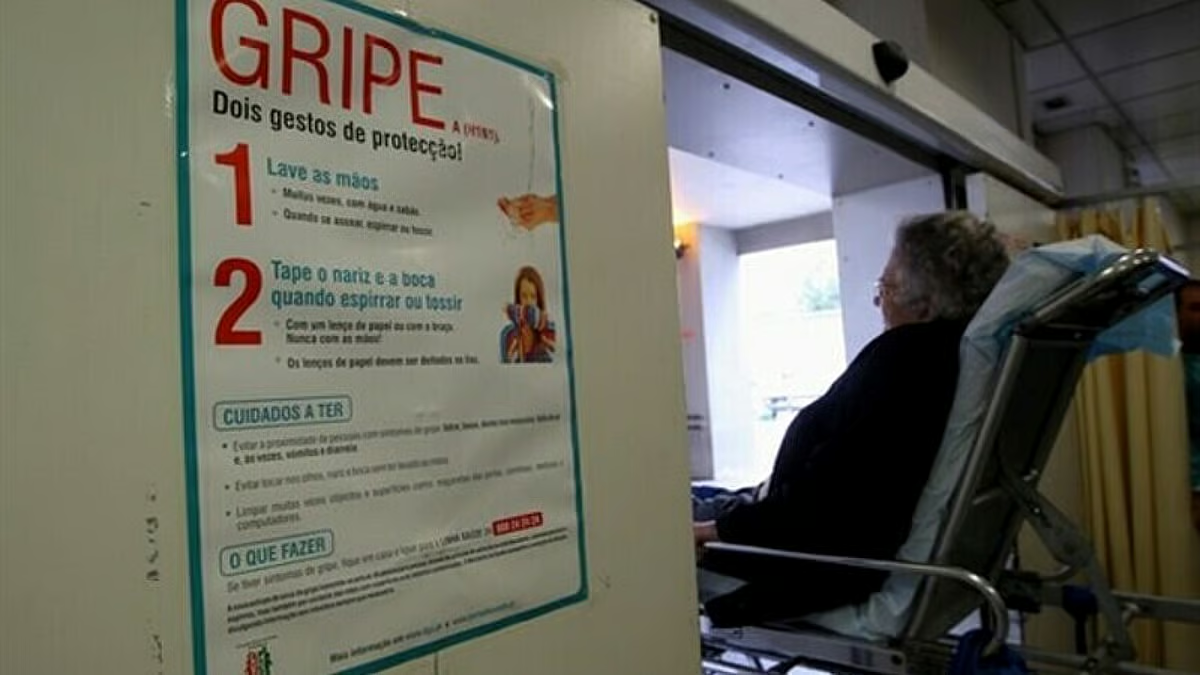

The Gripenet participatory surveillance system returns to operation this Friday, December 12th, allowing the population to collaborate in the monitoring and investigation of respiratory diseases and contributing to a more complete epidemiological view of these infections in the community, announced an INSA researcher.
The electronic platform that monitors the occurrence of acute respiratory infections – -, based on self-reported information by residents in Portugal, had been stopped since 2020 due to the covid-19 pandemic, with more than 2000 voluntary participants in 2019.
“The great advantage of Gripenet is that it complements traditional health surveillance systems” by including mild cases of respiratory infections, such as flu and Covid-19, of people who do not seek healthcare and who, normally, are not included in official statistics, researcher Verónica Gomez, from the Dr. Ricardo Jorge National Institute of Health (INSA), told Lusa.
Furthermore, it allows us to study factors associated with taking vaccines or seeking healthcare.
Data collected by Gripenet between 2011 and 2017 indicate that around 70% of people with any flu-like symptoms or signs of respiratory infection do not use health services.
“This is a sign that the vast majority of people do not seek healthcare when they have the flu. It is a large proportion of people” who are lost and which provides essential information to understand how respiratory infections circulate in the community and how the population reacts, whether by going to the doctor, contacting SNS 24 or staying at home.
The researcher explained that the platform had “a break” from 2020 onwards, coinciding with the start of the Covid-19 pandemic, “where all efforts in terms of human resources and others had to be allocated to combat the pandemic, namely at the Ricardo Jorge National Health Institute”.
“This period served to completely reformulate the platform, because in this way we were able to include other respiratory infections, not just influenza, which was the main focus of Gripenet”, highlighted the researcher from the Department of Epidemiology.
On the other hand, it also made it possible to standardize the methodology with the partners of the European consortium Influenza Net, to be able to have “an also European view of what is happening in terms of respiratory infections and improve the platform”.
According to Verónica Gomez, online registration is simple, with each participant being assigned a code so that researchers do not have access to their identification.
“Parents or legal guardians can complete questionnaires in relation to their minor children,” he explained.
Each participant registers on the electronic platform, filling out a characterization questionnaire and receiving a brief questionnaire every week to report the appearance of any respiratory symptoms during the week.
This questionnaire takes around three minutes to complete if there are symptoms and just a few seconds if there are no symptoms.
The results are presented weekly on the platform and will complement the information collected through classic surveillance systems for influenza and other respiratory viruses.
Gripenet was created by the Gulbenkian Science Institute in 2004, inspired by a Dutch system created in 2003.
In 2015 he was transferred to INSA, which coordinates the surveillance of influenza and other respiratory viruses in Portugal.