
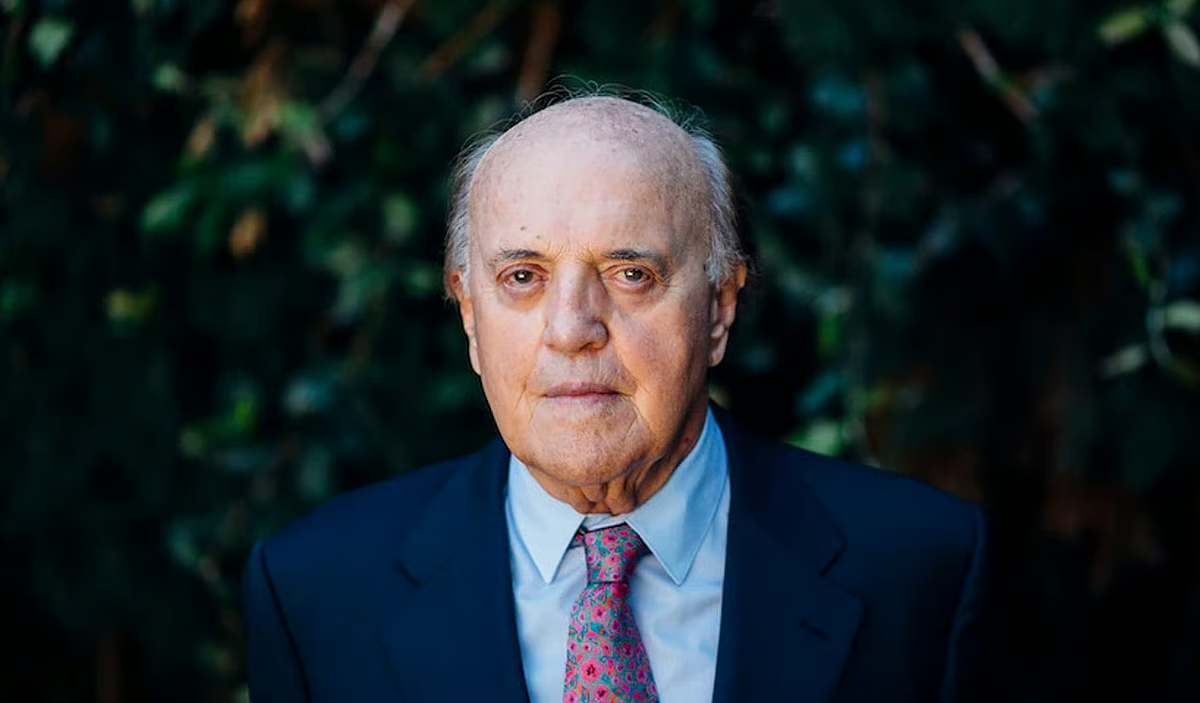

War reporter Peter Arnett died Wednesday, aged 91, in Newport Beach, California, United States.
For several years he covered the main world conflicts, with emphasis on the Vietnam War when he worked for the Associated Press (AP), which won him a Pulitzer Prize in 1966, and also the Gulf War for CNN, where he broadcast the war live on television for the first time from Iraq in 1991.
Arnett was born on November 13, 1934 in Riverton, New Zealand, and began his career at a local newspaper, the Southland Times. At the time, he had the dream of working in London, but he stopped in Thailand, where he worked at the English-language newspaper Bangkok World and, later, at another in Laos, where he established the contacts that allowed him to make the jump to AP.
At the North American agency he became a correspondent in Indonesia, ending up being expelled by the local government, following the financial crisis in that Asian country. He then went to Vietnam to cover the war.
“He was one of the greatest war correspondents of his generation. Intrepid, fearless and an excellent writer and storyteller. His printed and filmed reports remain a legacy for aspiring journalists and historians for generations to come,” said Edith Lederer, who was the AP’s war correspondent in Vietnam in 1972-73 and is now the same agency’s chief correspondent for the United Nations.
He became world famous in the Gulf War when he decided to remain in Baghdad before the US attack. According to the AP, when missiles began falling on Iraq’s capital, Peter Arnett broadcast live via cell phone from his hotel room.
“There was an explosion very close to me, you must have heard it”, he said, at the time, in a calm voice with a New Zealand accent, moments after hearing the boom of a missile attack.
With countless war stories, Peter Arnett told in 2013, during a talk to the American Library Association, one of the most striking episodes in the Vietnam war. It was in January 1966, when he joined a battalion of American soldiers on a mission and was next to the battalion commander when an officer stopped to read a map. “While the commander was examining the map, I heard four loud shots, with the bullets crossing the map and hitting his chest, a few centimeters from my face. He fell to the ground at my feet”, he recalled at the time.
Arnett was in Vietnam until the capital Saigon (now Ho Chi Minh City) fell into the hands of the North Vietnamese, and in recent days he received orders from the AP to destroy the agency’s documents because the war was coming to an end. However, he ended up not obeying the order and sent the documents to his home in New York, with the hope that one day they would be valuable, and are now in the agency’s archives.
In 1981, Peter Arnett left AP to join the newly formed North American television station CNN, from where he ended up resigning in 1999, after an investigative report narrated by him was taken off the air, revealing that lethal sarin gas had been used against American soldiers who defected in Laos in 1970.
In 2003, he returned to the Middle East to cover the second Gulf War for NBC and National Geographic, having also been fired for giving an interview to Iraqi state television, in which he criticized the US army’s war strategy.
Four years later, he was a professor of journalism at Shantou University, in the Chinese province of Guangdong. In 2014 he retired and moved with his wife, Nina Nguyen, to California.