
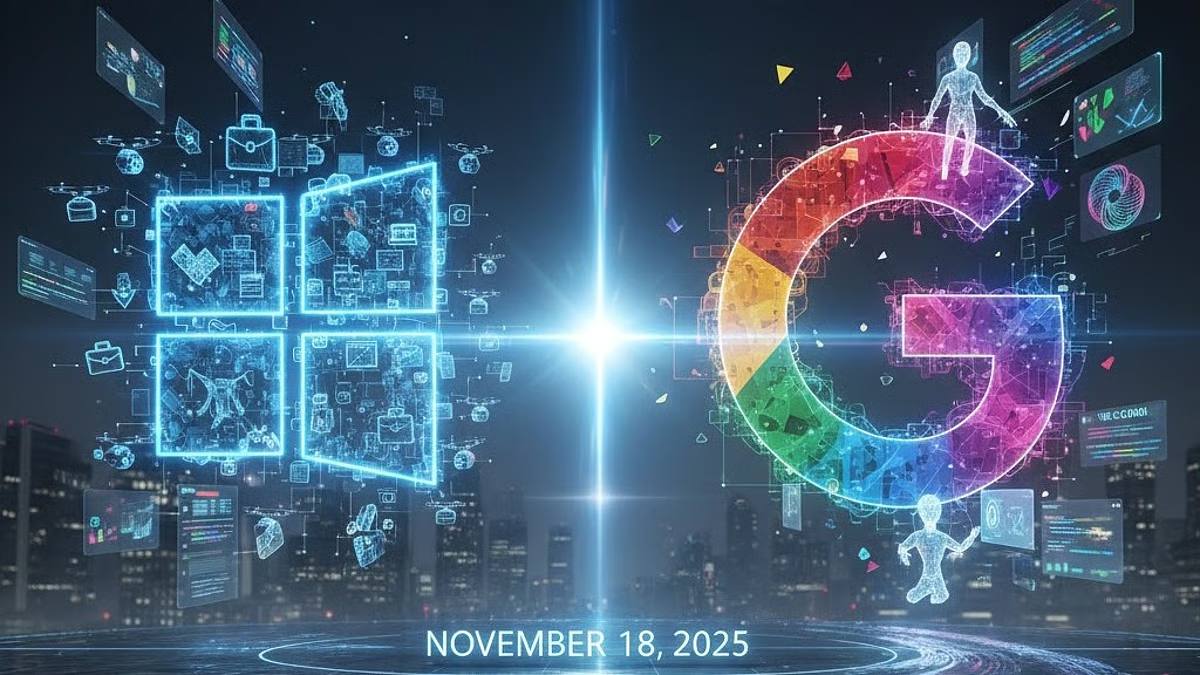

Last Tuesday, November 18th, will be marked as a turning point in the race for Artificial Intelligence. In a strategic coincidence, Microsoft, during its Ignite 2025 event (with a stage in San Francisco, USA), and Google, through a global launch, presented their visions for the next chapter of technology. And the conclusion is clear: we have officially entered the era of “autonomous agents”, AI modules capable of acting autonomously in various systems.
But the two technologies chose different paths to reach a position of greater dominance in a market that practically all analysts predict will be the near future of AI in our devices.
Microsoft: the corporate army
For Microsoft, the future happens inside the office. The company leveraged Ignite to launch Microsoft Agent 365, a platform designed to manage and protect AI agents within organizations. The strategy is pragmatic: instead of generic AI, Microsoft introduced what it calls specialized “digital employees”.
The technology revealed agents that take on specific roles: the Sales Development Agent to qualify commercial leads, new agents to manage teams in Teams and assistants that edit documents in Word and Excel autonomously. The goal is to integrate automation into existing workflows, supported by the new family of connected intelligence – Work IQ, Foundry IQ and Fabric IQ — that uses operational data to make real-time decisions.
In a demonstration of multimedia strength, the Redmond technology company also announced the integration of OpenAI’s Sora 2 video model into Microsoft 365 Copilot, allowing companies to create cinematic-quality marketing videos directly in their work tools.
Google: the creative brain
On the other side of the barricade, Google responded with what it calls “pure intelligence”, launching Gemini 3. Now available to all Pro users, the new model focuses on the reasoning capacity of its Deep Think machines and redefining how software is built. In other words, while Microsoft aims to help those who work, Google aims to give “superpowers” to those who create.
Google’s great innovation lies in the concept of “Vibe Coding” and the new Google Antigravity platform. These tools allow programmers — or even laypeople — to describe an idea in natural language and let the agent write, test and correct the code for entire applications autonomously. Gemini 3 will generate personalized and interactive visual interfaces for each user, adapting to the request at the moment.
Two visions, one goal
The divergence in approaches is evident. Microsoft estimates that, by 2028, there will be 1.3 billion agents automating tasks, according to a statement sent to DN, focusing on security and corporate governance through tools such as Microsoft Purview. Its value proposition is the immediate return on investment for companies “frontier” (cutting edge) that are leading digital adoption.
Google, in turn, is committed to versatility and solving complex problems, introducing “level of thinking” parameters that allow the model to reflect before acting.
With these simultaneous launches, the message to the market is clear: AI is no longer just a chatbot for chatting but has become an agent capable of doing things. It is up to users — individuals or companies — to decide whether they prefer a more “corporate” or more “creative” specialist. This is because AI will not disappear as if by magic.