
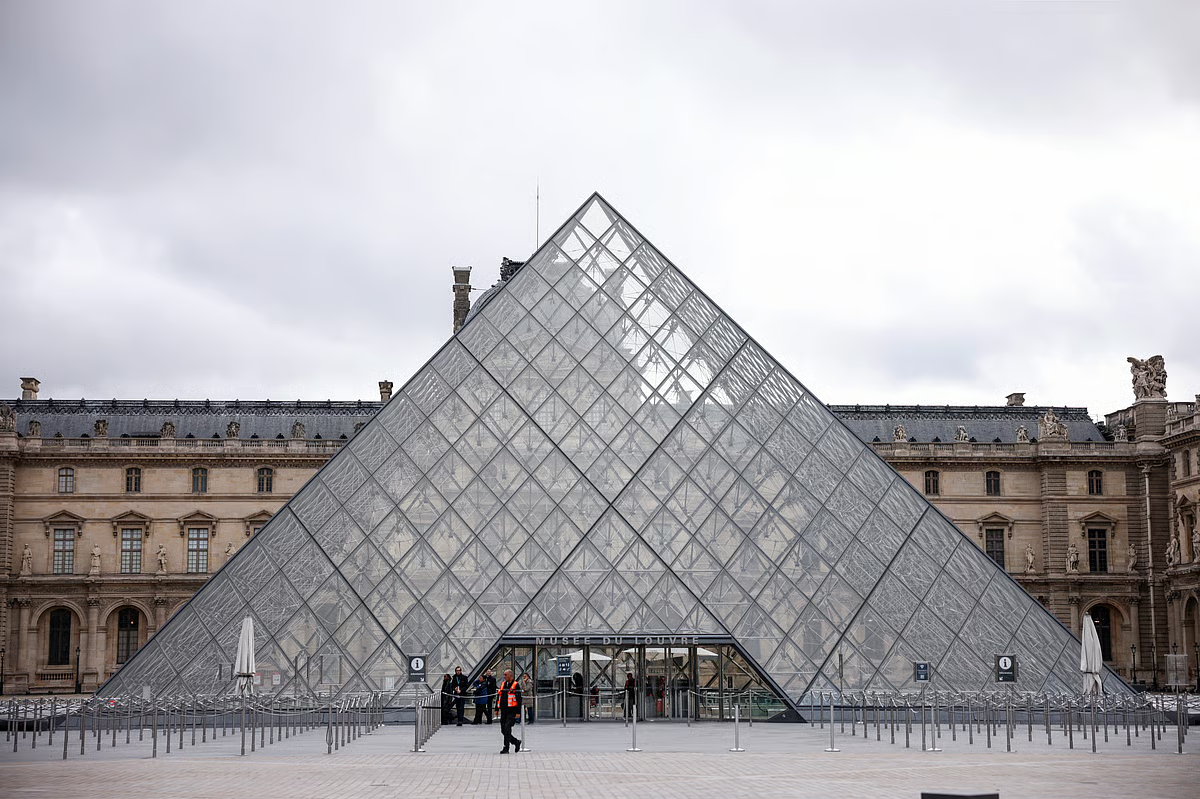

Employees at the Louvre Museum, in Paris, went on strike starting this Monday, December 15th, which could last for the following days, in protest against working conditions and the lack of resources.
The strike notice comes in a context of strong controversy due to the state of disrepair of some of its facilities and the theft of France’s crown jewels, which occurred in October.
“There is such a level of exasperation that everything indicates that the conditions are right for a very strong strike”, said this Sunday on BFMTV television the representative of the General Confederation of Labor (CGT) at the Louvre Museum, Christian Galani, whose union is one of those who called the strike, together with the French Democratic Confederation of Labor (CFDT) and the group of Solidarity, Unitary and Democratic unions (SUD).
Galani highlighted the need to “prioritize, to establish a hierarchy of emergency measures that must be implemented”, defending the need to focus on “the essentials, that is, the ruinous state of the building and the security of the institution”.
Furthermore, the union leader highlighted that, in the last 15 years, more than 200 jobs have been eliminated at the Louvre Museum, while the number of visitors has multiplied, making it the most visited in the world.
In this sense, Galani pointed out that the unions are opposed to the “differentiated pricing system” that the museum will apply within a month, considering that it “creates unacceptable discrimination between citizens of the European Economic Area and others”.
From January 14th, the price for residents outside the European Economic Area will increase from 22 to 32 euros, i.e. an increase of 45%.
A decision that the Minister of Culture, Rachida Dati, justified, arguing that “visitors who are not from the EU pay more for their entry and that this surcharge serves to finance the renovation of national heritage”.
In turn, the Ministry of Culture announced today in a statement that it has tasked the president of the public institution Reconstruct Notre Dame, Philippe Jost, with carrying out a two-month mission to propose “the necessary measures and changes to face the challenges identified and strengthen the heritage of the largest museum in the world”.
Jost, who will act under the supervision of Louvre Museum President Laurence des Cars and in close collaboration with museum staff and the Ministry of Culture’s Directorate-General for Heritage and Architecture, will have to present his initial recommendations by the end of February 2026.
This announcement came on the eve of the start of the strike at the Louvre, which was called the day after it became known that, on November 27th, several hundred ancient books were damaged by a flood caused by the failure of some pipes whose state of degradation was known in the antiquities library.
On November 17, the museum closed an office space and, as a precaution, a gallery of Greek antiquities located below, after detecting problems with fragility in some of the beams in that area of the complex.
But what generated the most controversy in recent weeks was the spectacular robbery of the museum on October 19, in which thieves accessed the Apollo gallery via a freight elevator and took the French crown jewels in broad daylight.
The four gang members were detained, but the jewelry could not be recovered.