
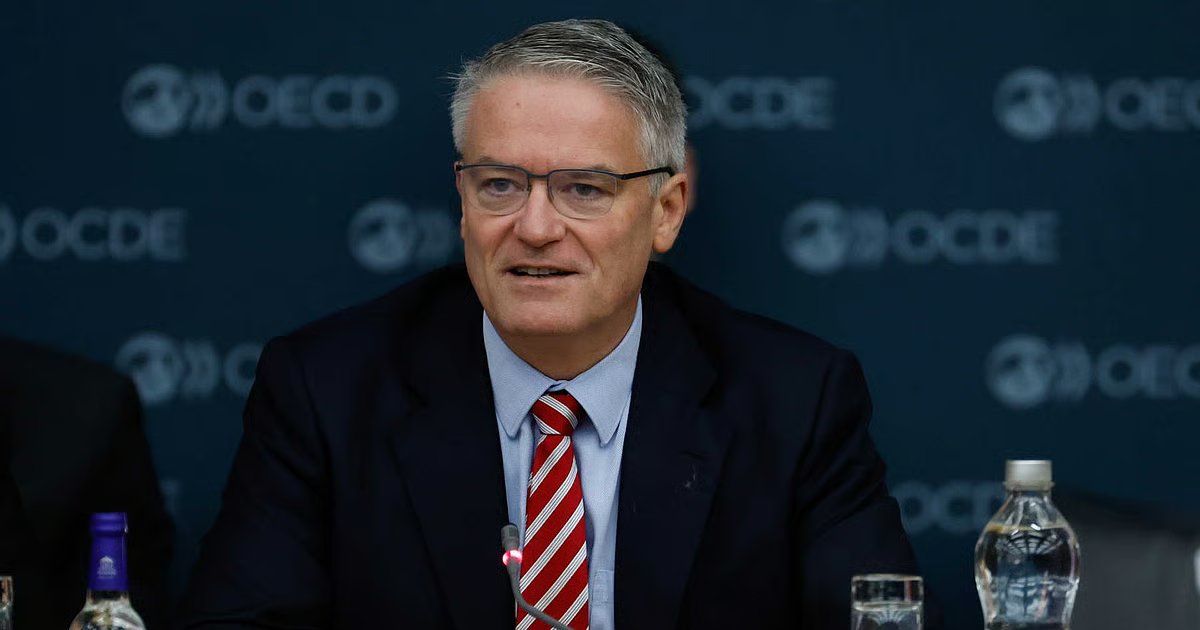

The OECD predicts that global economic growth will slow down in 2026, falling from 3.2% this year to 2.9% next year, with economic activity facing “fragile prospects”, associated with the impact of tariffs on global trade.
In the Economic Perspectives report, released today, the Organization for Economic Cooperation and Development (OECD) points to a moderation in the trajectory of the Gross Domestic Product (GDP) worldwide, with growth slowing from 3.3% recorded in 2024 to 3.2% in 2025 and to 2.9% in 2026, followed by a “small recovery” to 3.1% in 2027.
“Growth is expected to slow during the second half of this year [de 2025]as the anticipation of activity unfolds and higher effective customs duties on imports to the United States and China are reflected in company costs and final product prices, harming investment and trade growth”, describes the organization.
“The projections are based on the technical assumption that the bilateral tariffs announced in mid-November will be maintained throughout the remainder of the projection period, despite ongoing legal challenges in the United States”, he highlights.
In the introduction to the report, OECD Secretary-General Mathias Cormann highlights that “the global economy has proven resilient this year, despite concerns about a more pronounced slowdown following the increase in trade barriers and significant political uncertainty”.
However, it warns that the increase in customs duties should “gradually lead to higher prices, reducing the growth of household consumption and business investment”.
“These prospects remain fragile”, warns the organization’s top official, stressing that if there is an increase in tariffs, this movement is expected to cause “significant damage to supply chains and global production” and there is a risk that high asset valuations, made “based on optimistic expectations of corporate profits” driven by Artificial Intelligence (AI), will lead to “potentially abrupt price corrections”.
In the document, the OECD notes that “high geopolitical and political uncertainty will also continue to weigh on domestic demand in many economies”, with emerging economies in Asia expected to continue to be “responsible for the majority of global growth”.
For the United States of America, the OECD predicts GDP growth to be “2.0% in 2025, 1.7% in 2026 and 1.9% in 2027”.
China is expected to grow 5.0% in 2025, 4.4% in 2026 and 4.3% in 2027. In the second world economy, says the organization, “the end of the anticipation of exports, the imposition of higher customs duties on exports to the United States, the continued adjustment in the real estate sector and the weakening of budget support should reduce growth”.
Eurozone growth “is expected to slow slightly, from 1.3% in 2025 to 1.2% in 2026, before increasing to 1.4% in 2027, with the increase in trade frictions being offset by improved financial conditions, continued capital spending from Recovery and Resilience Mechanism funds, and the resilience of labor markets”, says the OECD.
In Japan, the economy is expected to “expand at a moderate pace, driven by expansionary fiscal policy next year”, with it expected to slow down from 1.3% in 2025 to 0.9% in 2026 and maintain the same pace in 2027.
For India, the OECD forecasts growth of 6.7% in the 2025-2026 cycle, 6.2% in 2026-2027 and 6.4% in 2027-2028.
Regarding inflation, the OECD expects it to decline gradually in most major economies. For the G20 countries, it is expected to increase from 3.4% in 2025 to 2.8% in 2026 to 2.5% in 2027.