
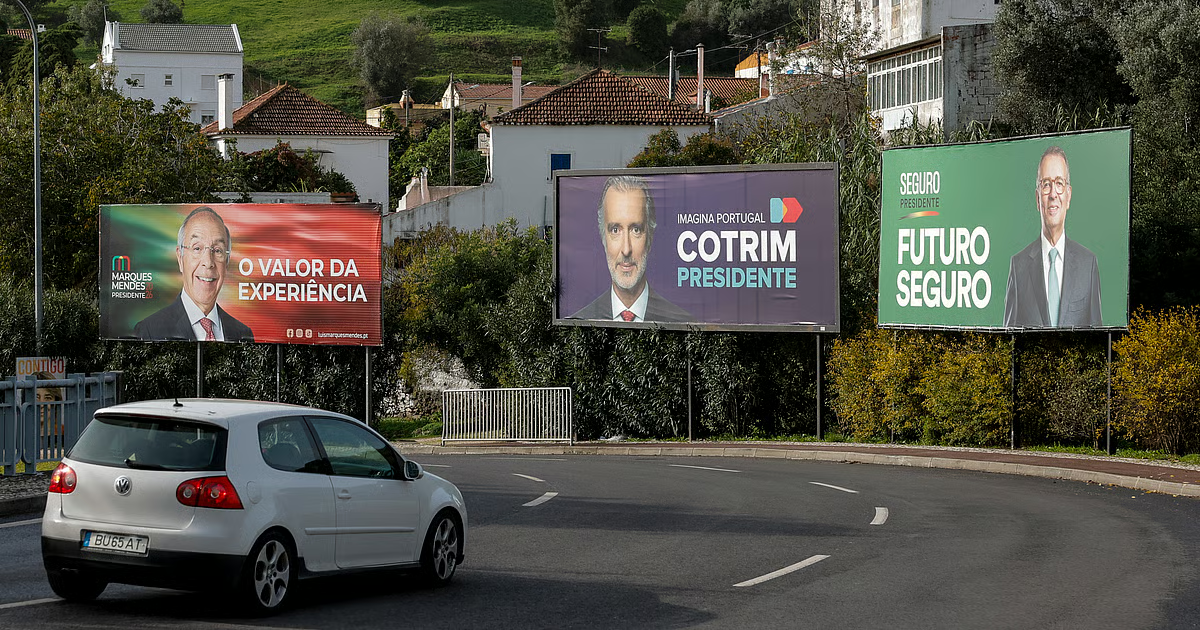

With slogans “so conventional, so banal, so close to nothing”, many posters seem like “a missed opportunity”, reduced to the “physicality, the halo” that each candidate emanates. “In most of them, no strategy was foreseen” and, in an uncertain cycle, the “minimalist messages” and “little memorable” materials, experts diagnose, are limited to marking territory, not mobilizing. Democracy, perched on outdoors measuring eight meters by three, it is seen reflected in paper: giant faces, small words.
“Look at me.
I already looked. And then?
That’s all.”
What should be a conversation starter between the candidate and the voter dies here. The poster exists, anyone passing by looks at it, communication ends in this mechanical gesture.
The short dialogue, launched by psychologist and publicist Pedro Bidarra, works as a diagnosis and could be the unintentional motto of this presidential campaign. Many of the posters – huge, silent, laminated in the urban landscape – seem to boil down to this: a request for attention without a promise, a face without a narrative, a presence without a voice. “It’s as if in a song the lyrics were just la-la-la; or, in this case, blah-blah-blah”, adds the psychologist and publicist, describing a communication that, instead of challenging, fears “making waves”.
When the poster doesn’t speak – it just looks
The protagonists are there – magnified, illuminated, but they don’t talk to us. Pedro Bidarra, experienced in political campaigns, recognizes a profound symptom in this muteness: the renunciation of communication.
“An 8 meter by 3 meter poster in the middle of the city is a means of communicating directly with citizens”, recalls Bidarra. But, in this campaign, “what all these posters communicate, with the exception of Ventura’s, is just Look at me, nothing more”. There is here, he says, “a missed opportunity”.
His musical metaphor crystallizes the criticism: “A poster is a bit like a song. A song has music and lyrics, a poster has an image and lyrics.” The image should transport the idea — the letter — to the voter’s memory. But “in these posters there are no ‘lyrics’ or what there is is so conventional, so banal, so close to nothing, that nothing remains except the image of the candidate.” They are empty melodies.
What’s left? Bidarra responds with brutal simplicity:
“Here is a man. Here is a woman.”
The phrases that accompany the photographs, he says, are “generalities without memory power: they don’t question, they don’t inspire, they don’t touch”. They are conventional, “interchangeable”, supported by an identical graphic for everyone, based on national colors. That’s why “all the posters look the same and blend into the landscape”. “Shuffle the phrases”, he challenges, to conclude: “you will see that they would fit each of them”, he says looking at phrases such as “My party is Portugal” (Gouveia e Melo), “Present President” (Jorge Pinto), “Futuro Seguro (António José Seguro) or even “Contigo.” (Catarina Martins). The only distinguishing element is the face. “The difference is only in the faces, in the physique, in the halo that each one emanates.”