
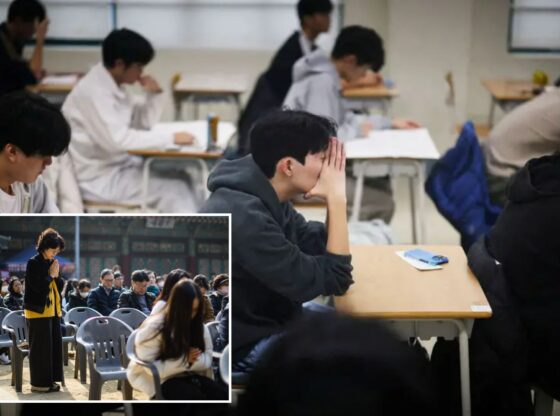

THE creator of an “insanely difficult” English test has been forced to resigned amid claims the exam is “impossible” to pass.
The South Korean exam boss stepped down over fury that this year’s notoriously gruelling entry test was “maddeningly” confusing.
The exam is an infamous eight-hour marathon of back-to-back exams held annually in November and is essential for admission to top universities.
Widely regarded as a gateway to social mobility, economic security and even a good marriage, it’s not unusual for students to begin preparing for the exam – named Suneung – from a tender age.
Some kids are sent to private tuition centres known as “cram schools” from as young as four.
Students attempt about 200 questions across various subjects, which include Korean, maths, English, social and natural sciences.

opening up
Kim Kardashian breaks down in tears and sobs as its revealed she failed law exam

CROWNING GLORY
Watch as gleeful Trump is gifted a GOLDEN CROWN in South Korea
This year’s exam sparked significant backlash due to the poor results for the English section because of how confusing the questions were.
Students were given just 70 minutes to answer the 45 questions of the English section.
Only three percent of students scored top marks in the English section compared to six percent last year- the lowest since absolute grading was introduced for the subject in 2018.
Oh Seung-keol, chief of Korea’s Institute for Curriculum and Evaluation, quit amid the backlash and apologised for “causing concern to test-takers and their parents, and for causing confusion in the college entrance exam process”.
He admitted that the test difficulty of the questions were “inappropriate”, despite several rounds of editing.
The agency also issued a separate apology, saying it “takes seriously the criticism that the test failed to meet the appropriate level of difficulty and the goal of reducing students’ academic burden”.
South Koreans take the exam so seriously that flights are grounded nationwide for 35 minutes during the English listening test to eliminate any potential noise.
Enormous pressure placed on students in South Korea’s ultra-competitive education system has been partly blamed for teenage depression and suicide rates that are among the highest in the world.
But English language professor Jung Chae-kwan told the BBC it was wrong to call the English test impossible.
“The texts aren’t necessarily impossible, but… maddeningly confusing,” he said.
“Teachers end up drilling test-taking hacks rather than teaching English… You don’t even really need to read the full text to get the points if you know the tricks.”
Could you pass the test?
Here’s a taste of what the students had to decipher in the test.
The first question asked students to place the sentence below into the correct part of the paragraph – either at 1, 2, 3 or 4.
“The difference is that the action in the game world can only be explored through the virtual bodily space of the avatar.”
A video game has its own model of reality, internal to itself and separate from the player’s external reality, the player’s bodily space and the avatar’s bodily space. (1) The avatar’s bodily space, the potential actions of the avatar in the game world, is the only way in which the reality of the external reality of the game world can be perceived. (2) As in the real world, perception requires action. (3) Players extend their perceptual field into the game, encompassing the available actions of the avatar. (4) The feedback loop of perception and action that enables you to navigate the world around you is now one step removed: instead of perceiving primarily through interaction of your own body with the external world, you’re perceiving the game world through interaction of the avatar. (5) The entire perceptual system has been extended into the game world.
The second question asked students to assess the political philosophers Immanuel Kant and Thomas Hobbes and analyse their views on the rule of law.
Kant was a strong defender of the rule of law as the ultimate guarantee, not only of security and peace, but also of freedom. He believed that human societies were moving towards more rational forms regulated by effective and binding legal frameworks because only such frameworks enabled people to live in harmony, to prosper and to co-operate. However, his belief in inevitable progress was not based on an optimistic or high-minded view of human nature. On the contrary, it comes close to Hobbes’s outlook: man’s violent and conflict-prone nature makes it necessary to establish and maintain an effective legal framework in order to secure peace. We cannot count on people’s benevolence or goodwill, but even ‘a nation of devils’ can live in harmony in a legal system that binds every citizen equally. Ideally, the law is the embodiment of those political principles that all rational beings would freely choose. If such laws forbid them to do something that they would not rationally choose to do anyway, then the law cannot be:
(1) regarded as reasonably confining human liberty (2) viewed as a strong defender of the justice system (3) understood as a restraint on their freedom (4) enforced effectively to suppress their evil nature (5) accepted within the assumption of ideal legal frameworks
The correct answer to both questions were 3.