
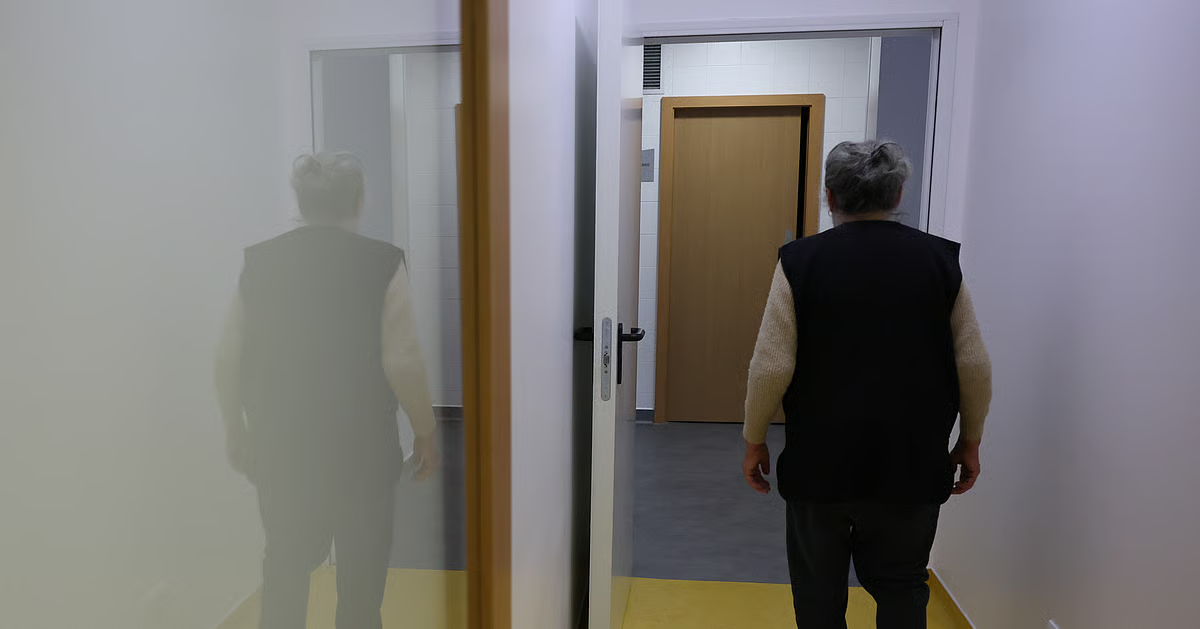

The number of elderly victims of crime and violence continues to increase, especially women victims of domestic violence, such as Odete, Etelvina or Gertrudes who currently live in a shelter after years of abuse by their husbands and children.
Data from the Portuguese Victim Support Association (APAV) shows that complaints have been growing: between 2019 and 2024, the number of victims over 65 years of age supported by the institution increased by 29%, from 1,341 to 1,730. In 2025, until August, 1,557 victims had already been supported, 75% of whom were women.
According to the Commission for Citizenship and Gender Equality (CIG), As of September this year, there were six elderly women in emergency care and another 27 in shelter homes. Currently, there are only two homes specifically designed for elderly women who are victims of domestic violence.
Six women currently live in one of these houses, “many from dysfunctional families and with great social and economic vulnerability”, but “also people from the middle/upper class” because the phenomenon is transversal, as a member of the technical team explained to Lusa.
He highlighted that these are phenomena of violence “that have lasted for a long time”. The aggressor can be the partner, but in around half of the cases it is the children themselves, and there are also situations in which the aggressor was the victim’s brother or stepson.
The member of the technical team said that in the case of children, the violent relationship goes back several years, and that victims “sometimes report that the adversity of dealing with them comes from childhood”.
Etelvina Silva, 62 years old, widow, has lived in the house for just over a month and said that her son hit her several times, the last time “punching her in the face, kicking her” and “breaking her head”.
“My son is a drug addict, he’s violent. If I didn’t give him money or tobacco, he’d hit me straight away,” he told Lusa.
He revealed that he had made several complaints against his son, as a result of which there was a court order not to approach his mother, but that was of little use.
He doesn’t know how long he will need to stay in the shelter, but he doesn’t want to go back to the house where he lived or see his son again: “I never want to see him again, ever again”.
The prolonged duration of the victimization also occurs in cases where the aggressor is the partner or spouse, sometimes starting during the dating period, as with Odete Pereira, 72 years old, who now wants to divorce her husband to whom she has been married for 45 years.
“I have always lived with domestic violence”, he stated, adding that there were “many attempts to end the marriage and leave home, but there were no houses like these”.
He described to Lusa a relationship “always with violence present”: “He said he threw me out the window and even hit me”.
The “final straw” was when her husband gave “a beating to her son, with more than 30 punches to the face” and Odete decided that “she could no longer live in fear”.
She called the police, filed a complaint and was sent to the shelter, where she arrived “in a state of shock”: “I had a series of days where I couldn’t move and I had so much pain in my neck that it felt like I had a neck made of stone because of the nerves I had built up”.
She reported that her “children are very marked” and said that she now hopes that they will help her “redo the last years of her life”: “What I wanted was to go back to my home because I got tired of working and I have the right not to lose my dignity and having to put up with this until I die is not fair”.
At the shelter she was able to not only rest but also “have feelings that I hadn’t had since before I was married”: “Feeling peaceful, feeling at peace, having joy”.
Gertrudes Pereira, 75 years old, if given the choice, would ask not to leave the shelter again. It has a difficult story to tell: raped several times by the same man, the first time when she was 64 years old. Later, he is the victim of physical attacks in the context of domestic violence by his stepson, the son of the partner with whom he lived.
For the technical team, the biggest challenge arises when looking for future solutions for these women. Many would need to integrate permanent social responses, such as places in homes, but end up overlooked in other cases considered more urgent.
“These ladies end up being doubly victims, because they are more isolated than the rest of the population and, therefore, if there is a faster response, there will certainly be greater emotional stability”, defended a member of the technical team.
He also pointed out that health is a major challenge in these cases, “because of age, some diseases that are not diagnosed”, in addition to cases of early dementia or other mental illnesses.
The psychologist explained, on the other hand, that there is often a picture of “a lot of emotional dependence” in relation to their aggressors, in addition to financial dependence, which often explains why these women remain with those who abuse them for so long.
“They are people with very low self-esteem because they spent years being told ‘you’re no good, you need me and you can’t live without me’ and, therefore, I try to work on their self-esteem and self-confidence”, he said, adding that he needs to explain to them that domestic violence is more than physical aggression and can also be psychological, financial violence or even neglect.
According to the psychologist, some of these victims “are in a very depressive state”, which is a challenge when defining an autonomy project and creating the conditions for these women to leave the shelter.
Domestic violence continues to be one of the crimes that kills the most in Portugal. As of September 30, there had been 19 deaths, 16 of which were women, approaching the 22 deaths recorded in the entire year 2024.
Tuesday marks the International Day for the Elimination of Violence against Women.
(Text by Susana Venceslau, journalist at the Lusa agency)