
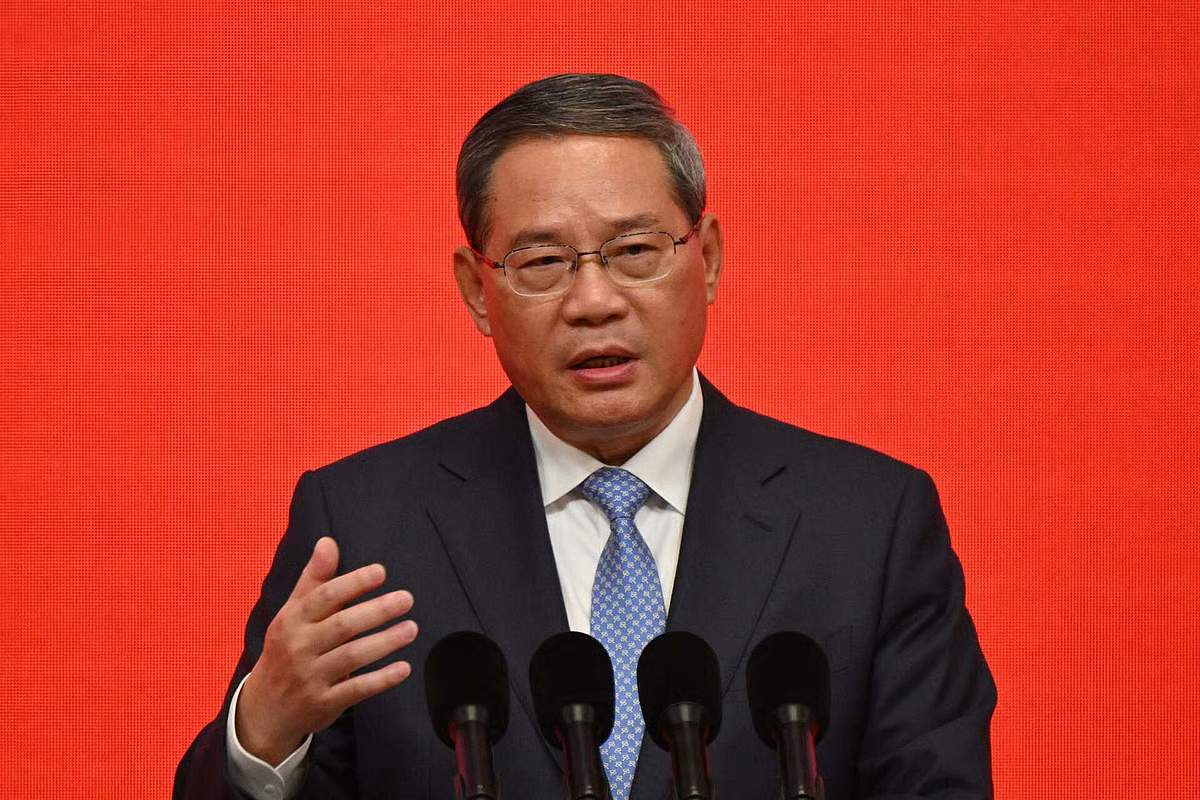

Chinese Prime Minister Li Qiang warned this Tuesday, 9th, of the “serious impact” of tariffs and other trade restrictions on the global economy, when inaugurating in Beijing a new edition of the ‘1+10 Dialogue’ with international financial institutions.
Li stated that the proliferation of trade barriers since the beginning of the year demonstrated that “tariffs harm third parties, but end up backfiring against those who impose them”, which, according to the government official, has reinforced global calls in defense of free trade.
Before the leaders of the main international financial and commercial institutions, the head of the Chinese Government highlighted that the world is facing “complex and profound changes”, marked by the rise of protectionism, geopolitical turbulence and gaps in global governance.
The forum, which takes place under the motto “Share global governance, promote global development”, aims to “build a more fair, reasonable and effective system”, said Li, highlighting the role of organizations present in the stability of the world economy.
The Prime Minister identified three key concepts that will mark the year 2025: tariffs, green transition and artificial intelligence (AI).
On climate, it marked the tenth anniversary of the Paris Agreement and reaffirmed China’s commitments, including the objective that more than 30% of the country’s energy consumption comes from non-fossil sources, with the installation of 3.6 gigawatts of solar and wind capacity – more than six times the level recorded in 2020.
Regarding artificial intelligence, Li highlighted the accelerated advancement of Chinese open models, such as DeepSeek, which are “driving industrial transformation” and the growth of new sectors such as intelligent robotics.
“Free trade, overcoming global challenges and collaborative innovation are goals that no entity can achieve alone. They require collective effort”, he highlighted.
Participating in the meeting are the director general of the International Monetary Fund (IMF), Kristalina Georgieva, the president of the New Development Bank, Dilma Rousseff, the secretary general of the United Nations Conference on Trade and Development, Rebeca Grynspan, and the president of the Asian Infrastructure Investment Bank, Jin Liqun.
Also present are the director general of the Bank for International Settlements, Pablo Hernández de Cos, the president of the World Bank, Ajay Banga, the director general of the World Trade Organization, Ngozi Okonjo-Iweala, and representatives of the International Labor Organization, the Financial Stability Board and the OECD, among others.
As in 2024, there is the possibility that participants will also meet with the Chinese President, Xi Jinping, although this meeting has not yet been confirmed.
Georgieva’s visit coincides with the final phase of the IMF’s Article IV mission, whose annual report on the Chinese economy will be presented this Wednesday in Beijing.
The ‘1+10 Dialogue’ takes place one day after the Politburo of the Chinese Communist Party announced that it will maintain a “more proactive” fiscal policy and a “moderately flexible” monetary stance in 2026, in a context marked by weak domestic demand, the risk of deflation and the persistence of the crisis in the real estate sector.