
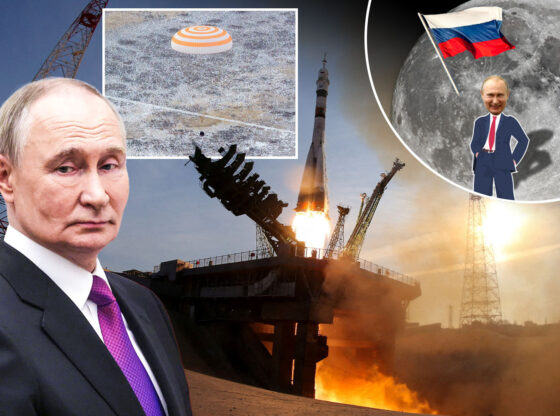

RUSSIA has unveiled bonkers plans to build a nuclear power station on the moon within the next decade.
The ambitious project is intended to supply energy for Russia’s lunar space programme and a joint research station with China.
Russia has historically been a major player in space exploration.
In 1961, cosmonaut Yuri Gagarin became the first human to travel into outer space.
However, that dominance has not carried into the 21st century.
Today, Russia trails behind the United States and, increasingly, China.

DANGER ZONE
Chernobyl radiation shelter will collapse if Russia strikes, director warns

BEHIND ENEMY LINES
Inside Ukraine & Russia’s assassination ‘shadow war’
The country’s space ambitions came under scrutiny in 2023 when its uncrewed Luna-25 mission crashed during landing.
At the same time, the landscape of lunar exploration has been transformed by private companies, particularly SpaceX.
Billionaire Elon Musk’s ventures have added renewed competitive pressure to national space agencies.
Russia’s state space corporation, Roscosmos, has said it plans to build a lunar power plant by 2036 and has signed a contract with the Lavochkin Association aerospace company to carry out the work.
The plant would provide power for rovers, an observatory, and infrastructure at the joint Russian-Chinese International Lunar Research Station.
“The project is an important step towards the creation of a permanently functioning scientific lunar station and the transition from one-time missions to a long-term lunar exploration program,” said Roscosmos in a statement.
While Roscosmos did not explicitly confirm that the plant would be nuclear-powered, Russia’s leading nuclear research organisations, Rosatom and the Kurchatov Institute, are involved.
Roscosmos head Dmitry Bakanov said the agency aims to use the power plant as a springboard to pursue future missions to Venus – Earth’s sister planet.
Russia is not alone in its interplanetary ambitions.
In August, Nasa announced plans to place a nuclear reactor on the Moon by the first quarter of the 2030 fiscal year.
“We’re in a race to the Moon, in a race with China,” said U.S. Transport Secretary Sean Duffy.
“To have a base on the Moon, we need energy.”
Although international rules prohibit placing nuclear weapons in space, there is no ban on nuclear energy sources.
The Moon, located about 250,000 miles from Earth, is believed to contain vast resources, including an estimated one million tonnes of helium-3.
Rare earth metals, essential for smartphones, computers, and other technologies, are also thought to lie beneath its surface.
Some experts predict this could spark a future lunar gold rush, as nations compete for the Moon’s valuable resources.