
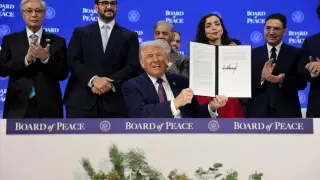

Donald Trump and his foreign policy team—the secretary of state, Marco Rubio; the special envoy, Steve Witkoff; and the businessman Jared Kushner— presented their reconstruction plans for the Gaza Strip this Thursday within the framework of the Davos Economic Forum.
The importance of the exhibition was more business – after all, they were trying to “sell” the project to the big investors gathered there – than purely political, but in the case of Palestine, the two issues can hardly be separated.
According to Kushner, who was in charge of presenting the project, the objective is to turn Gaza into something very similar to what can be seen in the emirates and Arab kingdoms of the Middle East.
The reconstruction would begin in Rafah, where they apparently have already begun to collect the rubble, and would go up towards Gaza City, with the construction of enough homes to create 500,000 new jobs and achieve 100% occupation, for the supposed benefit of the Palestinians.
Of course, as happens in Dubai or Qatar or Abu Dhabi or certain areas of Saudi Arabia, the attraction would be luxury: exclusive resorts with sea views and futuristic buildings that attract the attention of potential investors.
If all goes well, Kushner is confident that by 2035, Gaza’s GDP will be $10 billion. Currently, after two and a half years of war with Israel, it does not reach 500 million, according to estimates by UNCTAD (United Nations Conference on Trade and Development, for its acronym in English).
UNCTAD itself, in its report dated November 25, 2025, stated that reconstruction could last up to 22 years, but, according to Kushner, “at the pace of the Gulf countries, it can be done in two or three years.”
Kushner intentionally ignores the working conditions that make it possible to complete in two years what in another context would require twenty. In any case, it must be insisted, his intention was simply to attract investment, which, after all, is what he does in his private life.
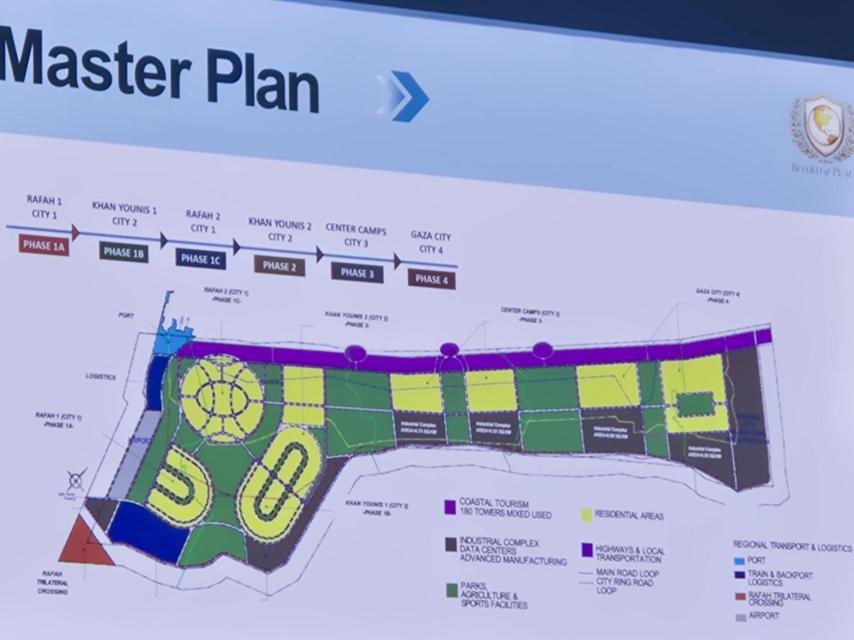
Slide from Kushner’s presentation of the New Gaza project.
Reuters
The Hamas issue
Kushner explained that, at first, the option of dividing the Strip into two was considered: one part, rebuilt, under the control of the so-called Peace Junta, and another, still dominated by Hamas terrorists, but in the end they have decided to make a plan for the entire territory.
Now, what happens then with the Islamist gang? According to Kushner, they have committed to handing over their weapons – Trump also assured this a few days ago, but there is no record of this – and they are counting on them to fulfill that commitment, which will be negotiated by the interim transitional government headed by the Bulgarian. Nikolai Mladenov.
“There is no Plan B,” Kushner made clear, “if in the end we fail it will only be because of Hamas’s refusal.”
It doesn’t seem like any situation. Hamas has dominated the Strip since the 2006 civil war against Fatah and the Palestinian Authority. Its presence permeates the entire society and every control body thereof.
It is understandable that the Trump Administration trusts that, by incorporating Turkey and Qatar, two of its sponsors, into the provisional Government of the Strip, they will convince the terrorists to hand over their weapons.
Iran is ignored and, above all, the Palestinian Authority itself is ignored, who, in principle, is legally responsible for the territory.
The White House’s approach follows the steps taken in Trump’s first term and which served to sign the Abraham Accords, which normalized diplomatic relations between Israel, the United Arab Emirates and Bahrain.
Instead of getting entangled in the fight between Israelis and Palestinians, the goal would be to join forces and put commerce above essence. Another thing is how this is going to be sold to the public opinions of these countries.
Netanyahu’s doubts
Because the truth is that, although it is said that the objective is for the Palestinian Authority—once it is “reformed”—to take charge of control of the Strip, it is clear that the plan is designed for foreign investors who can take over the luxury homes and turn Gaza into their vacation spot.
Investors who, for the most part, look like they are going to come precisely from the countries of the Persian Gulf and Saudi Arabia. What status that will leave Gazans in is impossible to know.
It’s not like Israel is jumping for joy either. Not, at least, its prime minister Benjamin Netanyahuwho is the one who has to give permission for international aid to enter and who has always viewed any progress in the living conditions of the Palestinians with enormous suspicion.
It is true that Israel, along with thirty-four other states, including practically all Arab countries, supports the Peace Board, but the idea that the Palestinian Authority ends up managing so many resources does not appeal to them at all.
Besides, there is the question of legitimacy. What authority does the so-called Peace Board have to make so many decisions and in whose name?
Beyond the obvious desire to invade the powers of the UN for the honor and glory of Trump himself, it will be difficult to convince investors to spend their money on projects that depend on an administration hand-picked by the United States and its Arab partners to convince the terrorists that their fight is absurd and, at the same time, overcome all Israeli fears.
Europe does not enter the game
The Arab world has made the independence of the Palestinian people its great political banner for almost eighty years.
There is a generation, led by the crown prince of Saudi Arabia, Mohamed bin Salmanand by the president of the United Arab Emirates, Mohammed Bin Zayed —MBS and MBZ, in international diplomatic jargon—who believe that this is an issue that must be left behind and that the future lies in collaboration with Israel and in the annexation by economic and non-military means of the currently occupied territories, even if that means leaving the Gazans in limbo.
In geopolitical terms, the fact that Trump is promoting a platform outside the United Nations and that he has leaders without any democratic pedigree – the only European countries that have joined are Hungary of Viktor Orbán and Belarus Alexander Lukashenko— is worrying.
We are facing, more or less, an “international of autocrats” with leaders like the Argentine Javier Mileywhose only asset on the Palestinian issue is simply liking Trump.
The fact that the permanent seats on this Board, for which we do not know what powers it will assume, are sold to the highest bidder already says everything about the humanist intention of the project.
It may be the path to peace in Palestine, but a peace based on dominance, or, as Trump likes to say “peace through strength”, which leaves liberal societies a little more alone.