

Among the various cinematic events that marked the year 2025, the premiere of Sharkby Steven Spielberg, in the summer of 1975, was the one that found the greatest media resonance. Given its narrative excellence and spectacular sophistication, let’s agree that there are good reasons for this, without forgetting the fact that we are faced with a premonitory fable about the decomposition of traditional ties between Man and Nature – it is worth, for example, knowing the documentary memory proposed by Jaws@50by Laurent Bouzereau (Disney+).
However, there are “hidden” memories that remain unmentioned. Thus, it was also 50 years ago (19 November 1975) that the film One Flew Over the Cuckoo’s Nestby Milos Forman, a filmmaker from the new wave of Czechoslovakia who emigrated to the USA in 1968 (where he had already directed, in 1971, Taking Off/The Loves of a Teenager). Understand: there are also good thematic and aesthetic reasons to remember this film based on the novel of the same name by Ken Kesey (ed. Livros do Brasil), but it is worth not forgetting its commercial performance.
To wit: Shark was a dizzying success (for better or worse, giving rise to the age of blockbusters), One Flew Over the Cuckoo’s Nestperhaps a film that, now, many will see as “difficult” and “intellectual”, was also an unusual financial phenomenon. In such a way that top of revenue in 1975 came to occupy second place, surpassing titles apparently more designed to fill dark rooms, such as the comedy The Return of the Pink Panther or the thriller The Three Days of the Condor.
There is another way of saying this which, being commercial, is also inevitably cultural – in fact, how can we think of one thing and another without taking into account the convulsions of its permanent contamination? One Flew Over the Cuckoo’s Nest belongs to a time (and respective markets) when cinema existed in a double and, as it turns out, energetic solitude: firstly, because films were the core territory of our relations with the world of images (for some reason, the 20th century was coined as the “century of cinema”); later, because the proliferation of television channels and, later, media platforms streaming It would be, at best, an unusual science fiction theme.
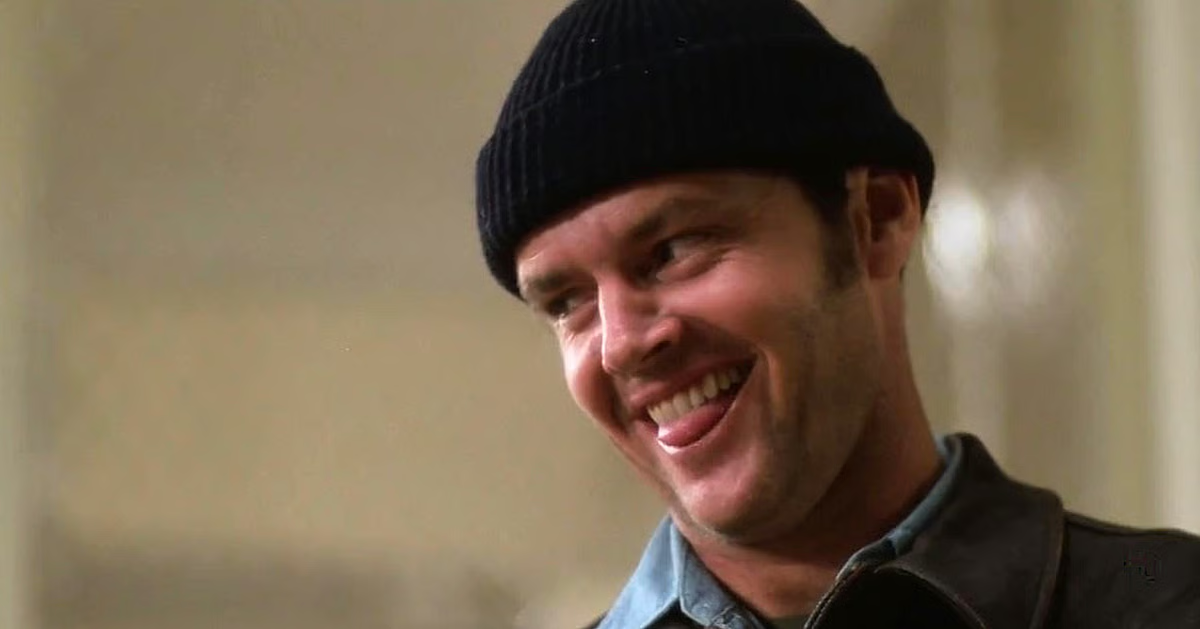
In a way that is as perverse as it is didactic, the film Forman he synthesized several vectors of the counterculture that punctuated our lives in the 1960s and 1970s. In truth, the character of RP McMurphy (Jack Nicholson in one of his most emblematic compositions), an inmate being evaluated in a psychiatric hospital, is far from being a mere rebellious patient – he combines the libertarian desires of a time that, between joy and tragedy, paid the price for its incurable utopias. At the same time, nurse Mildred Ratched (Louise Fletcher) does not end in her cold cruelty, emerging as the flag of a “system” that was not born to consecrate individual differences.
This is a curious topic for reflection for viewers (younger and beyond…) who confuse the commercial life of cinema with “superheroes” and “special effects”. We had, after all, a social fable, with something of a political pamphlet, that mobilized millions of spectators… And it also achieved the rare feat of winning the magical quintet of the Oscars (the so-called Big Five), winning in the categories of film, director, actor, actress and screenplay. It had only happened once before, with One Night It Happened (1934); later, it was only repeated with The Silence of the Lambs (1991).
Journalist