
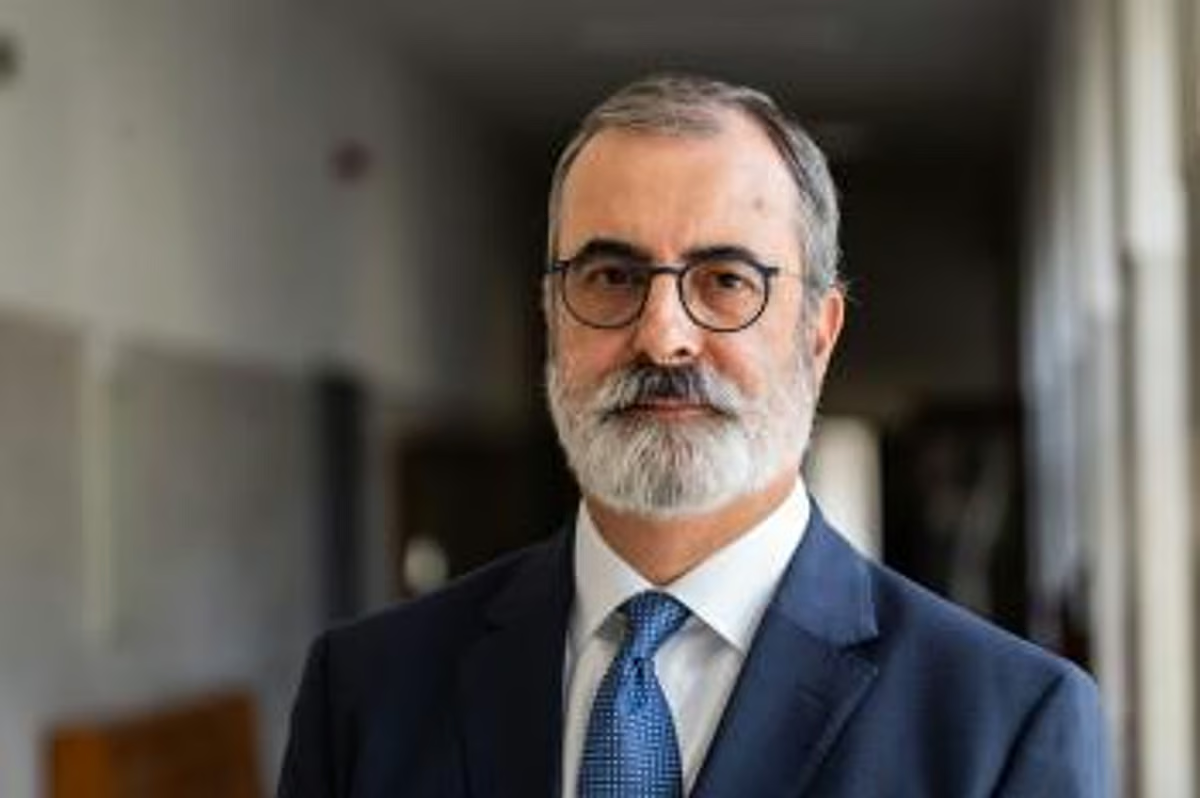

The professor and coordinator of Classical Studies at the Faculty of Arts at the University of Coimbra is best known for his work as a translator from Greek and Latin and it is this mission of translating the Bible that has occupied most of his time in the last decade. Not that Frederico Lourenço dedicated himself solely to the Bible, as he published two books with a bilingual edition of some Gospels, as well as other classic works.
Published two weeks ago, the sixth volume of the Bible has already arrived in bookstores and the same thing happened to the previous volumes, directly entering the top places on the sales charts. The author is asked if the reader is surprised that this translation is being done by someone who “began this work more than a decade ago, with an attitude of distancing from the Catholic Church”, as he himself writes in the preface. Frederico Lourenço explains the decision that led him to tackle a monumental work of several thousand pages: “I would say that there was a great advantage in the fact that I started all this work on the Bible during the long period of my life when I was away from the Church. I did not go into the work with the intention of claiming and proving the certainties of Catholicism, but rather with a rational attitude and open to the journey that the work on the Bible would provide me.” He adds: “I did not start with conclusions defined in advance, as happens in the theological study of the Bible, but with everything open. I let the study and deepening of the themes take me to the point at which the objective analysis of the problems would inexorably have to arrive. The journey consisted of the intellectual process of objectively understanding the Bible, instead of searching, in the Bible, for confirmation of pre-acquired certainties.”
It is not difficult to confirm the enthusiasm with which this volume was advanced when reading the various introductory notes to the various texts and, especially, the footnotes that add enormous understanding to the reading of the Pentateuch. Hence the translator is questioned about how much “this journey through the Bible” made him return “to the serene experience of Catholic practice” and whether he justifies “rethinking” his “ex-Catholic identity” because he is more enlightened. Go further; Is rereading the Bible the solution for Catholics who are at odds with their Church to recover their faith? Answer: “The experience of faith is different for everyone and each individual has their own personal story of closeness and distance from the Church. In my case, my departure from the Church never represented a departure from Jesus Christ and his message. I have been a conscious follower of Jesus since I realized, as a child, what that means. My love for Jesus has never wavered an inch throughout my adult years, although I cannot hide the fact that the Catholic Church in which I was baptized and educated has disappointed me many times. But my current attitude is not to demand perfection from the Church, because I myself am not perfect and I have neither the authority nor the sanctity to throw stones at anyone. Furthermore, my return to the Church has been marked by daily surprise regarding the generous welcome of the people who are the Church: I am referring to both the clergy and the Catholics who regularly attend the Church.”
Frederico Lourenço considers this VI volume the most important of the Old Testament, having brought forward its translation and left Volume 2 of the V volume unfinished. One cannot avoid the big question of whether this change of plan is due to being tired of a task that has already taken many years? Explain the reasons for changing the order like this: “An idea that sometimes crossed my mind was that it would be a shame if I died without having translated the most important part of the Old Testament: the Pentateuchwhich is contained in this Volume VI. I don’t expect to die soon, but it calmed me to leave the least interesting volume of the Old Testament until last and launch myself directly into the task of working on the Pentateuch. The decision was decisive for me, because it was the trip through Pentateuch which made the reservations I had about returning to the Church crumble.”
In the introduction to the book LeviticusFrederico Lourenço asks a question: “Who is the recipient of the laws that are codified here?” The answer he gives is that these laws apply exclusively to Israel. So, you want to know, how does this “legislation” deal with the war that Israel is waging? The translator points out that it is an “absolutely critical issue”. Continue with your thoughts: “Before knowing in depth the PentateuchI thought it represented the insurmountable obstacle that prevented me from identifying myself as a practicing Catholic. How can a Christian accept some of the barbarities that are attributed to God in this set of five books? I ended up finding my intellectual path in this labyrinth – it will be the theme of my next book -, which showed me that it was possible to have faith and belong to the Church, without however having to swallow everything that the ancient Israelites wanted to put into the mouth of God. I just give the example of Deuteronomy 21in which the parents of an alcoholic son are allowed to hand him over to be stoned to death. I do not accept that this procedure is possible for Christian parents of an alcoholic child. I say the same about the authorization repeatedly granted by God to the Israelites in the Bible to exterminate other peoples who shared the same land with them. We have to accept that God did not and does not say everything that is appropriate for men for Him to say.”
The translator makes a point of referring to the transfiguring power of poetic intuition in theological reading and, in parentheses, exalts it: “What would this world be without poetry?” Are believers as touched by poetry as the translator, one wonders: “The question of the poetic beauty of the Bible hit me very hard in my adolescence, when I first read the novel Brideshead Revisited de Evelyn Waugh. There we speak of the adoration of the shepherds and the wise men in the manger of Bethlehem; and one of the characters in the novel says that she believes the evangelists’ report because it is so beautiful. It is as if beauty were itself a confirmation of truth. I read and re-read the New Testament Gospels in Greek daily: it is my main exercise of devotion. And every day I am amazed at the extraordinary beauty of the text. Jesus’ words are of transcendent poetic beauty. In my understanding, the theological interpretation of the Bible maps this beauty in terms of an architectural structure whose arch connects the Old Testament to the New. It is as if the individual books of the Bible were loose stones from different eras, which Theology puts together to build a building even grander than St. Peter’s Basilica.”