
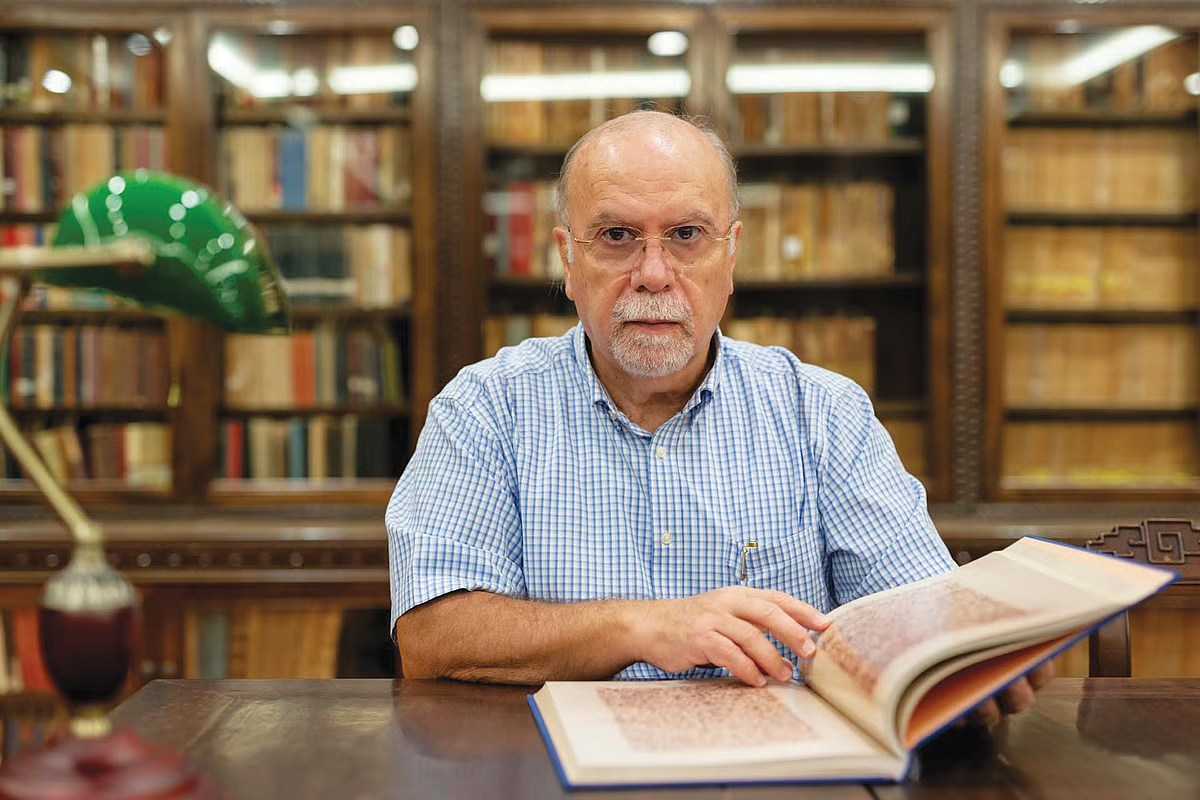

A national decoration, in China, for foreigners, and which recognizes my contribution to the University of Macau, to Macau and, I believe, also to the relations between Macau, China and Portuguese-speaking countries, namely Portugal, where I come from.” It was in this way that, at the microphones of Radio Macau, Rui Martins commented, at the beginning of October, on his distinction with the highest honor granted by the Chinese authorities to foreign citizens: the Friendship Award from the Chinese Government.
The vice-rector for Global Affairs and professor of Merit at the University of Macau received the award, in its 2025 edition, alongside 49 other laureates, in a ceremony held at the Grand Palace of the People, in Beijing, as part of the celebrations of the National Day of the People’s Republic of China. The distinction recognized the recipients’ exceptional contributions to the country’s economic, social and scientific progress. In the case of Rui Martins, it is an award that reflects not only a unique academic career, but also the strategic impact of his work. Since moving to Macau in 1992, the specialist in the field of integrated circuits and microelectronics has played a key role in promoting technological innovation, stimulating the training of local talents. Under his direction, what is now the State Reference Laboratory for Analog and Mixed Very Large-Scale Integrated Circuits was founded, the first of its kind outside Mainland China. Furthermore, it has also taken an active role in promoting cooperation between China and Portuguese-speaking countries, fostering academic and scientific partnerships with institutions in Portugal, Brazil, Angola and Mozambique.
From Lisbon to Macau: a transformative decision
Now 68 years old, Rui Martins was born in Lisbon, but grew up in Mozambique. He graduated in the field of Electrical Engineering at the Instituto Superior Técnico of the University of Lisbon, where he would teach for 12 years. In 1983, he designed a chip with analogue functions and, in 1991, he became the first researcher in Portugal to develop a chip as part of a doctoral thesis, also at Instituto Superior Técnico.
After completing postgraduate studies, he had a promising career in Europe ahead of him. However, in 1992, he made a bold decision: heading to Macau, a place that was then preparing to, in 1999, have the status of a Special Administrative Region of China.