
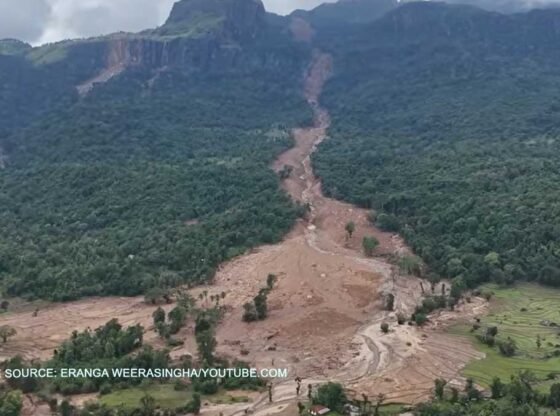

ECONOMYNEXT – A shock to Sri Lanka’s gross domestic product in 2026 from Cyclone Ditwah is likely to be at least partly offset by the effect of reconstruction, as well as a fast-normalizing economic activities, officials said.
There are expectations that the loss of output would be limited to the first quarter, IMF Mission Chief Mission Chief Evan Papageorgiou said, though more time and data was needed to get a firm idea.
Hopeful of Temporary Shock
“This is something that we have to very carefully think and examine, particularly with how the response also plays out,” he said.
“Of course, there is a very large degree of uncertainty, and I hope you can understand this.
“Now, our preliminary estimate, and that I have to caution the word preliminary, is that growth will likely take a hit in the short term.
“Short term could mean perhaps one quarter, could perhaps even be even less, but we cannot really equate the growth rate with the economic loss, because economic losses clearly are going to be very, very important, and they’re going to be sizable.”
The IMF will be watching high frequency data such as tourism arrivals and electricity output to gauge how activity is bouncing back.
Cyclone Ditwah destroyed about 108,000 hectares of paddy, which is anyway in low lying land, but most of it can be replanted.
The cyclone brought vast swathes of the nation to a standstill and people stopped buying goods and stocks in shops in inundated towns were destroyed in several towns and sales and purchases halted.
Deputy Minister of Economic Development Nishantha Jayaweera said it was too early to say anything about value added tax collections but excise revenues appear to have softened.
Some distilleries have gone under water and about two million people were displaced
Time to Normalize
Deputy Minister of Finance and Planning Anil Jayantha Fernando says there are no reliable measures of the actual output loss as yet.
“The economic loss will depend on how quickly the economy comes back,” Minister Fernando said last week.
“If things come to a standstill the economic loss will be greater. If economic activity resumes quickly the loss will be less.”
The government has announced a series of compensation measures to get production of agriculture, animal husbandry, small and medium industry back on track.
A damage assessment from the World Bank is due soon, he said which will have more reliable data.
Sri Lanka domestic tourism came to a standstill and foreign tourism reduced somewhat, but industry officials say the South Coast hotels are full.
Most roads have been made passable. The government is to spend 500 billion rupees extra. Some foreign funds are also coming.
The government has collected a lot of data on actual losses to infrastructure, businesses and people.
Broken Window Fallacy
When GDP is calculated loss of capital stock is not counted. But reconstruction adds to GDP.
“Reconstruction will also add to growth, like the broken window fallacy,” Minister Jayantha explained.
The Broken Window Fallacy, is a parable related by French classical economist Jean-Baptiste Say involving a glazier who replaces a broken window and gets some money, which will have knock on spending across suppliers and workers.
All this adds to output (GDP), but what also happens is that only some lost capital stock has been replaced.
Minister Fernando said it was the intention of the government to rebuild what is replaced with better infrastructure.
The government has already said that roads will be augmented with slope strengthening and people will be shifted out of landslide prone areas. The compensation hopefully would result in better houses for the least well off.
“As you can understand, construction is likely to support growth during the rebuilding phase, and because of the size of the economic damage, this is likely to add to GDP considerably,” Papageorgiou said.
“But that doesn’t mean, of course, that the country hasn’t had a severe economic shock.”
One of the problems with government or private disaster spending is that money spent on reconstruction comes from funds that could have been used elsewhere, for real expansion of the capital stock, as pointed out by Say himself.
Prices
Sri Lanka could face higher prices from supply shocks, Papageorgiou said.
“In addition to that, we project higher inflation, at least for the short term, again, due to shortages in selected food items and some supply chain disruptions from damaged infrastructure and import control and import ability.
“Now, equally important is the external balance. Reconstruction spending is already kicking in.
“We think that the current account deficit is likely to widen at least for the next six to 12 months due to the increased food and construction import rates, the lower agricultural exports, and potentially some reduced tourism earnings.”
Sri Lanka started having balance of payments troubles in February 1952, after the newly set up central bank abandoned its initial deflationary policy in the first 18 or so months after its creation.
Sri Lanka has generally grown higher than the IMF’s conservative 3.1 percent rate after default with the central bank providing exceptional monetary stability with broadly deflationary policy, unlike the economic currency and collapses triggered by stimulus and high inflation targets since the end of a civil war.
Say’s LawSri Lanka central bank warned local fx swaps are a ‘hot money operation’ by COPF members
Sri Lanka is planning to finance 500 billion rupees of additional spending in 2026, mostly with a cash buffer made up of extra borrowings, which have been deposited not in the monetary authority (as colonial administrations did before 1950 which led to a rise in foreign reserves) but in state commercial banks.
Commercial banks appear to have deposited some money in the central bank, at least at first, loaned some in in the interbank market for other banks to give credit, and may have also bought government securities with the money.
Analysts are watching as to what the effects will be seen in the banking system as money from the large ‘single depositor’ is withdrawn from state banks and spent on goods and services.
Sri Lanka is planning to raise around 500 million dollars in external finance as well, President Disssanayake said. The IMF has already provided 200 million dollars.
(Colombo/Dec21/2025)