
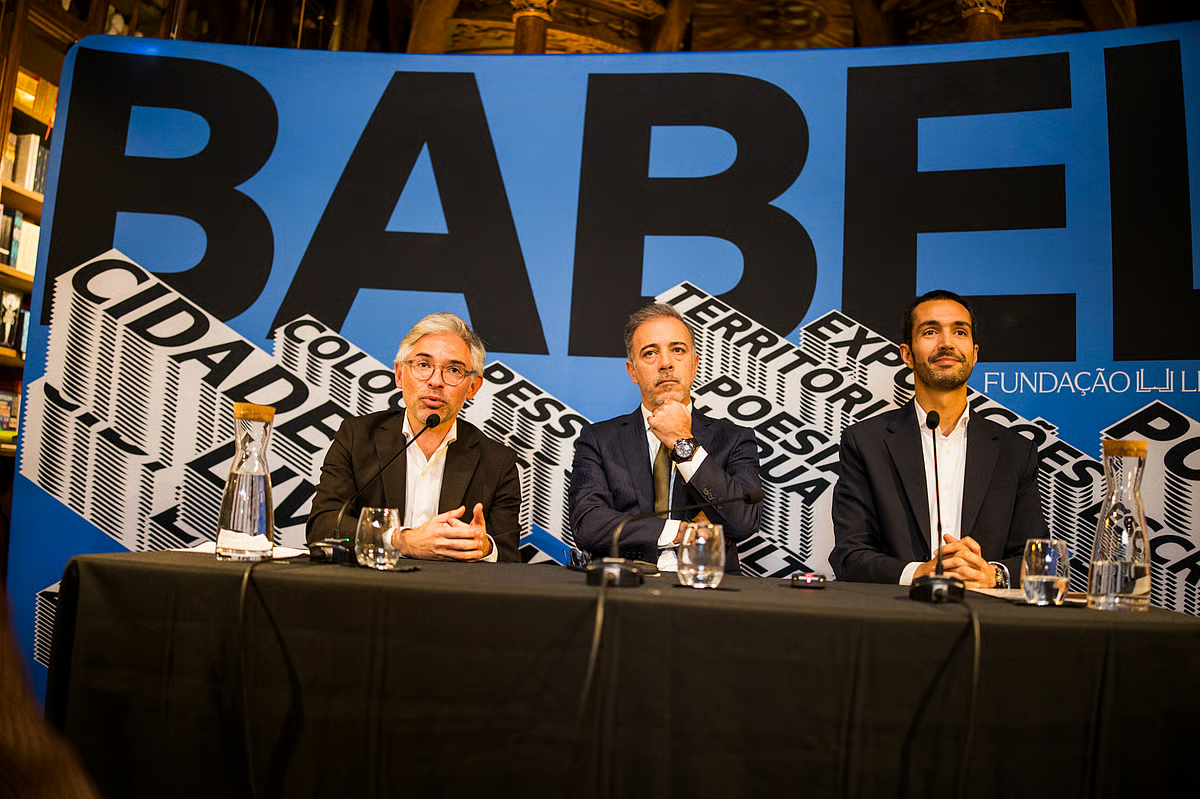

Independence, words and cultural politics
Babell was born from an independent initiative by Fundação Livraria Lello, which challenged Rui Couceiro to curate the project, but has been in coordination with public authorities from the beginning. Jorge Sobrado, councilor for Culture, present at the session, highlighted this independence as a political virtue. The municipality, he stated, values projects conceived outside the direct supervision of public authorities, respecting free initiative, even if participating through support, collaboration or co-production. Porto, he added, “is not agnostic when it comes to culture: it has a militant faith in words and books”.
This centrality of the word runs through the entire project. For Sobrado, Porto’s literary status cannot be separated from its political consciousness. The city is, historically, “a place of the word” — of poets, fiction writers, playwrights, journalists, philosophers and orators — but also of libraries, publishers, bookstores and second-hand booksellers. For the councilor, thinking about Porto without books would be an ontological impossibility. It is in this context that Babell emerges as a response to “a contemporary urgency”: the crisis of thought, language and human relationship capabilities. The word, he recalled, is the founder of the human and constitutive of the city.
“The contemporary image of Porto”
On the municipal side, the message was convergent: Babell’s independence is not a problem to be managed, but a characteristic to preserve. Pedro Duarte insisted that this “It is not a Chamber project”, but an initiative that arises from society, with the public sector being responsible for “facilitating, supporting and expanding” without conditioning.
Financing will follow this logic: own and external production, capital from Fundação Livraria Lello, support from partners to be announced and institutional collaborations. Couceiro wanted to make it clear: the expected economic return is for the territory — “not for ourselves”, because the organization will invest. The visual identity, developed by Stúdio Eduardo Aires, follows this intention of urban inscription, aligning itself with the “contemporary image of Porto”.
The model that distinguishes Babell
If the name explains the philosophy, the model explains the novelty. What distinguishes Babell from other literary festivals is the way in which sessions are accessed and the explicit attempt to link an event to the effective creation of readers. Couceiro explained the origin of the idea: around ten years ago, when investigating the impact of literary festivals on reading habits, he concluded that the results were not very encouraging. People watched it, but they didn’t buy more books or read more because of it.
The solution is to use the book as a “bargaining chip”. At Babell, anyone can stop and watch a session in a square. To sit down, you will have to buy a book in one of the nearly seventy bookstores in the city that are being mapped, including second-hand bookstores. The purchase – a one euro book, for example – entitles you to a code that allows you to reserve a place in a specific session online. “The organization does not receive any commission on these sales”, guarantees the commissioner, reinforcing the objective – to build a direct bridge between programming and cultural consumption of the book.
The city made on foot
Babell also wants to test the connection between literature and mobility. Work is underway with STCP, Metro do Porto and Transportes Metropolitanos to associate the purchase of the book with a transport ticket valid during the festival week. The scale is assumed: audiences for around two thousand people in squares in the city center, which will imply mobility plans and traffic restrictions.
The experience was designed as a walking trail. The sessions do not overlap and will have thirty-minute intervals: fifteen for leaving and entering, fifteen for travel. The locations will be less than a fifteen-minute walk from each other, in a practical demonstration of “15-minute cities”a concept created by academic Carlos Moreno. The design of the festival is part of the argument here: Porto can function as a walkable city when the programming is designed for this.
Babell will take place from the 24th to the 30th of June in Porto. However, the opening, on Saint John’s Day, will take place in Leça do Balio (Matosinhos), next to the Leça do Balio Monastery, headquarters of the Livraria Lello Foundation, with the inauguration of Jardim do Pensamento. The garden, with four hectares on the bank of the Leça River, is a joint project by Siza Vieira — responsible for fourteen sculptures — and Sidónio Pardal. The inauguration will feature a conference by worker-philosopher Byung-Chul Han on slowing down, disconnecting and reconnecting with nature.
From the following day onwards, the festival takes place in the center of Porto, in outdoor spaces to be defined with the municipality. The reason, explained Couceiro, is simple: “Porto comes first for the people of Porto”.
What will happen
The full schedule will be announced later, but the power lines will be made public. There will be programming for children and young people, curated by children’s literature author Adélia Carvalho; exhibitions, including a sensorial experience guided by the visual poet Luís Fernandes (João Habitualmente), designed to be heard and felt in a ruined space; a large exhibition at the Portuguese Photography Center, with portraits of imprisoned writers, signed by Daniel Mordzinski, an evocation of the prison, in that space, of Camilo Castelo Branco and a starting point to reflect and celebrate freedom of expression.
Exhibitions by artist Ana Vidigal, talks on education and reading in conjunction with the Chamber, and “Porto History Classes” are planned – from gastronomy to science, from medicine to literature. And poetry, which will also take place on the streets. There will be concerts and an event newspaper directed by writer Patrícia Reis, who is also responsible for the programming.
International poster with local soul
Couceiro mentioned some names already confirmed. In addition to Byung-Chul Han, Olga Tokarczuk (2018 Nobel Prize winner), Salman Rushdie and Margaret Atwood were announced. Despite the strong international dimension, the distinction is clear: “the soul is from here”. The poster will be guided by Porto and Portuguese writers and artists, “projecting the city outwards without decentering it”.
In the final speech, the president of the Chamber, Pedro Duarte, summarized the political reading of the project: Babell can have “a gigantic impact” on the life of public spaces and the creation and intensification of literary audiences. It fits into the idea of a city where “culture is a structuring pillar” — the basis that gives meaning to the rest. There is, at Babell, he said, a “very trippy” boldness and ambition: thinking big “and getting your hands dirty”, in a logic of network work, in which booksellers, second-hand booksellers, cultural and public agents can, together, win.
Babell presented itself as an attempt to correct a known problem: events that mobilize attention but do not change practices. Porto, in Rui Couceiro’s report and in the validation of the municipal executive, is not just a setting; is an instrument. And the name — Babell, with two “l”s — serves as a final reminder: diversity and abundance not as noise, but as a method.