
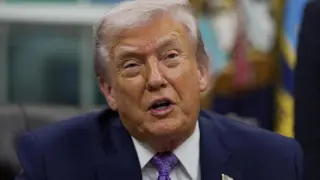

Venezuela woke up with panic in its blood. The announcement by the president of the United States, Donald Trumpthe blockade of sanctioned oil tankers in Venezuelan waters has put the citizens of the Caribbean country on alert. Thus, many have gathered at gas stations in various cities to fill the tanks of their vehicles due to the threat of a possible fuel shortage.
The measure declared this Tuesday by Trump would prevent sanctioned ships from entering or leaving Venezuelan territorial waters, increasing pressure on the regime. Nicolas Maduro and the country by preventing its main source of income and foreign currency.
According to the strategy of the North American country, this would aggravate the economic asphyxiation of the Chavista leadership, which allegedly directs the so-called Cartel of the Suns, along with anti-drug operations, which have resulted in the death of a hundred alleged drug traffickers in the waters of the Caribbean.
After US forces intercepted the Skipper ship, leaving Venezuela and with several recorded voyages to Iran, and confiscated the crude oil it was transporting, at least 30 sanctioned vessels have been identified in the vicinity of Venezuela, according to the maritime intelligence firm Windward, several of which have modified their course to minimize the possibility of sharing the fate of the Skipper.
These belong to the so-called ‘ghost flotilla’, which transports crude oil from countries sanctioned by the United States and which represent 40% of the ships that arrive in Venezuela to load crude oil, according to data from Transparencia Venezuela. Vessels participating in this black market often turn off their transponders, change their flags and names, and emit false location signals to avoid detection.
These are facts that lead Venezuelans to get ahead before scenes like those of 2019 are repeated, when the waits to be able to purchase gasoline could take days of waiting meters from the refueling station.
Throughout the capital, queues can be seen in front of gas stations, and several reports indicate that in cities such as Valencia and Barquisimeto they stretch for several kilometers. In these cities there is also a crisis in public transport, already irregular, and there are fears that several drivers will stop providing their services if they do not see profitability, a situation also experienced in previous years.
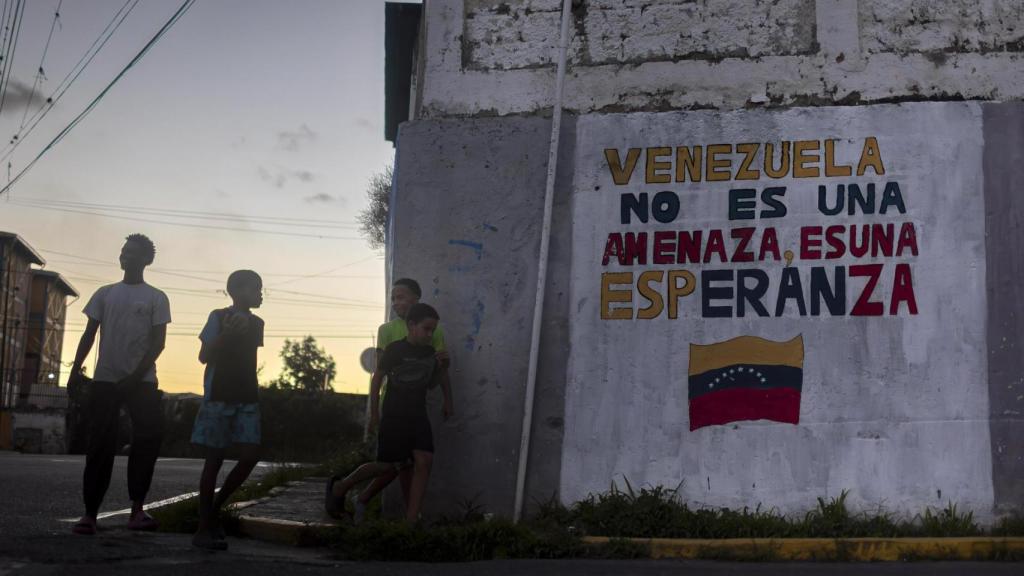
Young people walk next to a mural in Caracas.
Efe
A man waiting at a gas station near the Chuao housing estate speaks out, indignant, about the prospects of this situation. “It is something that affects me in my businesses because I sell raw materials for local industries, and without energy, I cannot meet my clients,” he exclaims.
Engineer by profession, remember that Venezuela lost more than 20,000 oil technical experts since the government of the former president Hugo Chavez and they were replaced by people who did not know how to manage the industry’s resources, leading “to the collapse of refining in the country, so Venezuela does not currently export gasoline, but imports from countries like Brazil, Iran and even the United States.”
“And several newspapers say that these oil tankers were going to Cuba, that they do not pay for our oil and in turn negotiate its sale to China,” explains the engineer.
Benigno Alarconpolitical analyst and founder of the Center for Political and Government Studies at the Andrés Bello Catholic University (UCAB), highlights that “it is evident that there will be a significant impact on the Government’s cash flow and also internally due to the dependence we have on additives for gasoline production.”
“Evidently, negative expectations can become a self-fulfilling prophecy because no country can tolerate the entire population going out to pump gas at the same time,” he says.
It also points out as additional problems that “Venezuela’s oil storage capacities are limited and if it is not possible to extract all the oil produced, production levels must necessarily be reduced” and that “as the risk of oil transportation increases, costs also increase, which translate into a greater discount in the final prices at which Venezuelan oil can be placed.”

United States President Donald Trump and Secretary of State Marco Rubio in a file image.
Reuters
The military invasion: reality or bluff?
In addition to the possible gasoline shortage, several Venezuelans expressed contradictory feelings of fear and expectation regarding the possible start of military operations within their territory.
The rejection by the US House of Representatives of two initiatives to withdraw US troops from the Caribbean was one of the signs that several commentators and media personalities from both countries interpreted as the prelude to a formal declaration of war.
For the third time, the floor failed to pass resolutions invoking Section 5 of the War Powers Resolution, which would allow Congress to order the president to withdraw the Army if a joint resolution exists.
In the words of the leader of the Democrats in the Senate, Chuck SchumerTrump “does not have the authority” to “use military force in the Caribbean without authorization from Congress,” although he later failed to get the votes needed to remove soldiers from the Caribbean.
In Trump’s appearance on Wednesday night, the president barely made any reference to the “bloody cartels” that he accuses of attacking Americans through drug trafficking, regarding which he limited himself to saying that “the arrival of drugs by sea and land has decreased by 94%,” without mentioning the declaration of the Maduro administration as a foreign terrorist organization.
Shortly before the bloc’s declaration, it had stated that Venezuela had illegally taken away “energy rights” from the United States. “We want our oil back,” he had said.
Shortly after, the White House deputy chief of staff, Stephen Millerassured that he was referring to the nationalization of the Venezuelan oil industry in 1976, which he described as “the biggest robbery” in the history of the United States.
For his part, Maduro insists in his statements on the obligation of Venezuelans to defend the territory of the “puppet government” that he alleges that the United States wants to impose, referring to the opposition leader. Maria Corina Machadowho has openly supported Trump’s pressure methods.
The mobilization of military and civilians has reached the point of forced recruitment, including adolescents and the elderly, for military bodies called Bolivarian Militias, according to the United Nations Human Rights Council.
According to an expert consulted by EL ESPAÑOL, who declares on condition of anonymity, the military escalation seeks the collapse of the Maduro regime.
“No major clashes or any prolonged resistance are predicted, quite the opposite, because neither the majority of the military sector nor the civilian population would take its side to defend it,” he declares. “Ordinary people want political change and do not care if it happens through negotiation, pressure, intervention, or coup d’état, and many say they perceive that Washington’s problem is not with them, but with the Maduro regime.”

Venezuelan President Nicolás Maduro addresses members of the armed forces, the Bolivarian Militia, police and civilians during a demonstration against a possible escalation of US actions towards the country.
Reuters
Blackouts across the country
Around the last hours of sunshine on Wednesday, several areas of Caracas and other states lost power. They are no longer the multi-day blackouts that characterized the worst stages of the crisis before dollarization in 2022, but in the last two years they have been repeated at key moments of the country’s political crisis, such as in the days before and after the presidential elections in July 2024.
In one of the many houses in Caracas, Margarita, who prefers to testify under a fictitious name, holds a candlestick with a lit candle while she checks her appliances. “This is horrible, the house is very dark and I had to look for the candles we had saved because this is not something new,” he laments.
As he speaks, some lights come on before going off again a few minutes later. The candle flame continues to tremble. “It has already gone out more than four times, I am worried about the refrigerator, the washing machine and the cell phone, because one of these blackouts burned a computer that I had connected,” says the woman, who now sits waiting for the electricity to return.
On the street, several areas are covered in blackness that is barely touched by the lights of passing cars. At certain intersections the traffic lights are also turned off, creating scenes of chaos amidst the blare of bugles that warn of accidents that almost never happen.
And if these irregularities last several hours in the capital, it is worth remembering the numerous reports that indicate that each crisis that afflicts it multiplies in severity in the other states of the country.
The fear of a new series of blackouts like those in 2019, which lasted up to more than five days, covers the cities. The lack of maintenance of the Guri dam, the country’s main hydroelectric complex, is manifested in these electricity losses, the last of which occurred in mid-2024, although Chavismo spokespersons blame alleged sabotage by opposing political forces.
When the power comes back on, Margarita starts checking the refrigerator to see if it’s still working. “A Cuban woman told me that this is a tactic of Castroism to give ephemeral joy, as if the arrival of light and water, which we also often lose, were a gift.”
Several houses on the same street are beginning to recover the points of light in their windows that, seen from the outside, look like cocuyos.