


The European leaders meeting this Monday in Berlin offered Volodímir Zelenski the deployment of a multinational force in Ukraine, that its army maintain 800,000 troops in peacetime and that the United States lead “a monitoring and verification mechanism” after the entry into force of a possible ceasefire to supervise its compliance. These are some of the proposals that the Merz, Macron, Starmer and company included in a joint statement that they made public on Monday night.
The idea of deploying continental troops in Ukraine is nothing new. The plan was born last March within the Volunteer Coalition with the stated purpose of “assisting in the regeneration of Ukrainian forces, in the security of Ukrainian airspace and in supporting maritime security, including operating within Ukraine.”
The proposal, however, will never have the endorsement of Vladimir Putin. The Russian president will not accept “under any circumstances” the presence of European soldiers in Ukrainian territory, as the Russian Deputy Minister of Foreign Affairs recalled this Tuesday, Sergei Ryabkov. “No, no and not again,” stressed the number two of Sergey Lavrov in the chain ABC News.
In any case, the meeting in Berlin between Ukrainians, Europeans and Americans served to clear up some of the doubts that had accumulated since the Trump Administration decided to give one last push to the peace negotiations in Ukraine to try to break out of the loop of recent months.
The tandem that makes up Donald Trump’s special envoy, Steve Witkoffand his son-in-law, Jared Kushnerheld a series of meetings last weekend with the Ukrainian delegation to iron out differences, exhibit closeness—less than what they exhibited weeks ago during their visit to the Kremlin, in any case—and find a formula that would convince kyiv to give in to Russian territorial claims in the Donbas.
Zelensky, who dropped this Sunday his proposal to integrate Ukraine into NATO, slipped this Monday that Trump’s emissaries had offered him a measure similar to Article 5 of the Alliance. “We have five documents. Some of them refer to security guarantees: legally binding, that is, voted and approved by the US Congress,” Zelensky told several journalists via WhatsApp.
For now, the Trump Administration is silent on this issue. He limits himself to reaffirming that the security guarantees for Ukraine will be “very solid”, but that in no case will they deploy US troops on the ground.
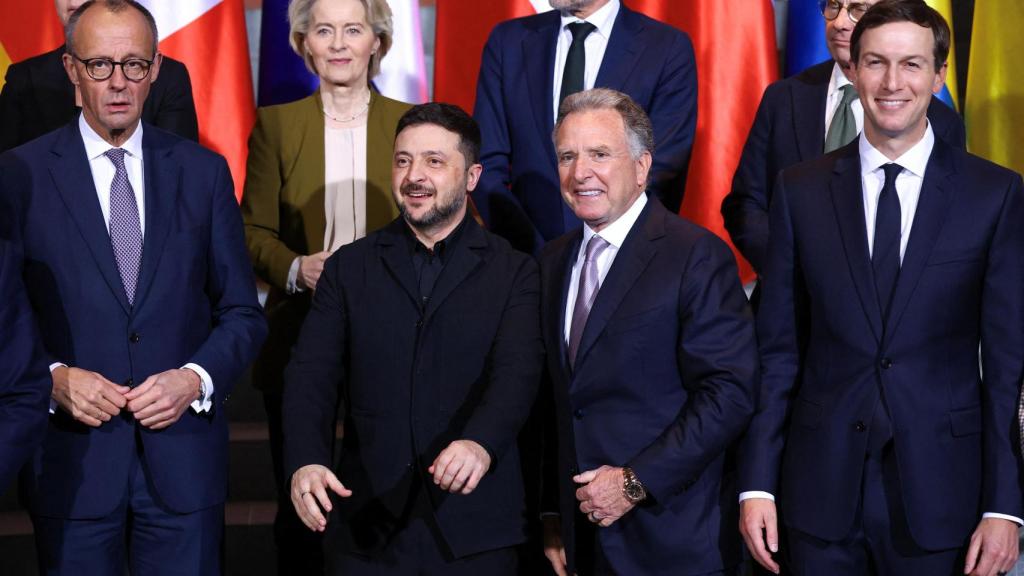
European leaders receive Donald Trump’s negotiators, Steve Witkoff and Jared Kushner, and Ukrainian President Volodymyr Zelensky in Berlin.
Reuters
Where Zelensky does not give in is in Donbas. The Ukrainian leader has left the door open to holding a referendum so that citizens can make decisions about the territories.
“They want our Donbas. And we don’t want to give up our Donbas,” remarked Zelensky, who also spoke about Washington’s proposal to create a ‘free economic zone’ in the region: “The Americans want to find a compromise and offer a ‘free economic zone’. And I want to emphasize once again: ‘free economic zone’ does not mean under the leadership of the Russian Federation.”
And Moscow intends to extend its sovereignty over the Donbas. It claims areas whose troops do not even control after almost four years of war. “Our position is well known. It is consistent, transparent and clear for the Americans. And, in general, it is also clear for the Ukrainians,” the Kremlin spokesman declared at a press conference this Tuesday, Dmitri Peskov.
“Who will control these territories politically and militarily? That is the question,” he says in conversation with this newspaper. Oleksiy Haranprofessor of Comparative Politics at the National University of Kyiv. “It is Ukrainian territory, and what the Russians are suggesting is that they would like to consider it Russian territory.”
Haran acknowledges that the Donbas could be, why not, a demilitarized zone in the future, “now, if Ukraine withdraws its troops, Russia should also withdraw its own. Same distance, same strategic depth. That’s how it works. And yet, the Kremlin says it would deploy the Russian National Guard on the ground.”
Unjustified euphoria
US officials boasted Monday that “90%” of the peace process was complete. In fact, Trump himself assured at the end of the summit in Berlin that peace in Ukraine had never been closer. An appreciation shared by the German Chancellor Friedrich Merz. But Washington’s triumphalist tone clashes with the maximalist stance verbalized by the Kremlin.
Zelensky stressed this Tuesday that the last aspects of the agreement with the United States still need to be closed. Something that will happen “in the next few days.” When that time comes, Trump’s emissaries will present these proposals to their Russian interlocutors. “So far we have seen newspaper reports, but we will not respond to them. We have not seen any text yet,” Peskov himself commented on this matter.
According to Zelensky’s logic, if Putin says no again, then he will be justified—that is, it will be a “fair request,” in his words—to ask the United States for more weapons and more sanctions against Russia. But he doesn’t have it all with him.