
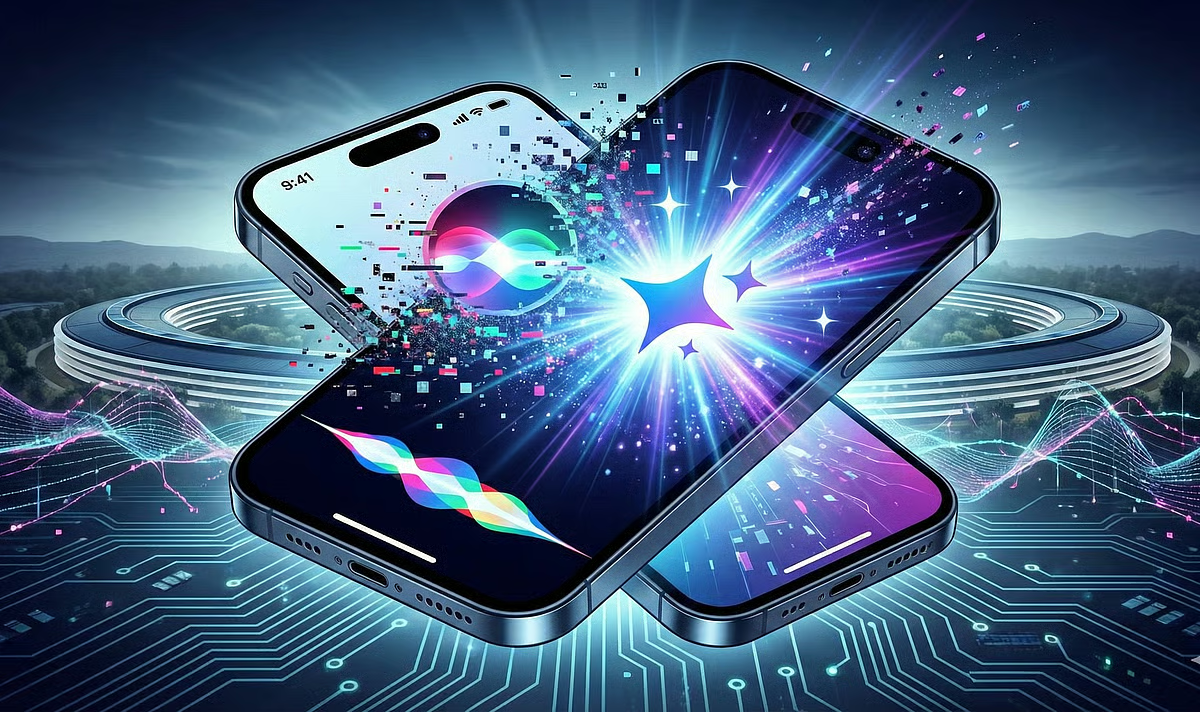

The collapse of internal strategy
Apple Intelligence, officially introduced under this name in June 2024 as the company’s response to the generative AI revolution, has stumbled in execution. Recent reports indicate that Apple’s tools have suffered from severe “hallucinations” – including sending notifications with algorithmically generated fake news – and technical instability.
The industry reacted promptly to the change in leadership. Marina Koytcheva, Director of Research at STL Partners, cited by the specialized website The Register, stated that this move “means that Apple knows it has lost the AI race”. For the analyst, Subramanya’s hiring indicates that the company is now dependent on market leaders, namely Google and Microsoft (which has a strategic partnership with OpenAI), to rebuild its own strategy.
Tim Cook, Apple’s CEO, tried to de-dramatize the situation. In a statement, he thanked Giannandrea, but focused on the future: “AI is central to Apple’s strategy and we are pleased to bring Amar’s extraordinary experience to the team.” However, behind the scenes, the reading is clear: Apple needed someone who knew the competition’s “engine” from the inside.
A billion-dollar deal
The centerpiece of this new phase is a commercial partnership that is being finalized, valued by Bloomberg at around one billion dollars annually. This agreement provides for Google to license its Gemini models to run natively on the iPhone, as opposed to being a simple application. Sources close to the process reveal that Apple will use its Private Cloud Compute infrastructure to run a customized version of the 1.2 billion parameter Gemini model.
This hybrid architecture will allow Apple to benefit from Google’s advanced reasoning, while maintaining the promise of privacy, ensuring that users’ personal data is not absorbed by Google’s servers for algorithm training. This solution works, in essence, like a “brain transplant” for Siri. While Apple continues to develop its internal models – which currently only have around 150 billion parameters and are insufficient for complex tasks – Gemini takes on the heavy lifting of planning and summarizing information.
The Google paradox: winning by losing
Google’s strategy therefore appears to be counterintuitive. By giving up its “crown jewel”, the Gemini, to the iPhone, the Mountain View company takes away one of the main selling points for its own Pixel phones and the devices of its Android partners, such as Samsung. However, market analysts and antitrust experts suggest this is a masterstroke by a company that is, at its core, a software and advertising powerhouse – after all, Alphabet (Google’s parent company) makes 80% of its revenue from services and advertising.
By becoming the AI engine of the iPhone, Google secures vital strategic wins that outweigh any losses in mobile phone sales. First, it blocks OpenAI, which would be its biggest existential threat if it became the default “intelligence” on 2 billion Apple devices. Secondly, the agreement reinforces Apple’s dependence on Google. In fact, it already pays the apple brand 20 billion dollars a year to maintain the search monopoly on Safari, guaranteeing in exchange the data that ensures that its algorithms continue to mediate the world’s relationship with information, regardless of the device or system that the user holds in their hand.
This restructuring led by the hiring of Subramanya thus confirms a new reality in Silicon Valley: for Apple to maintain hardware supremacy, it had to accept renting the “soul” of the software to its biggest rival.