

A GIANT dome at the Chornobyl nuclear plant that was built to contain radiation is no longer functioning after a drone attack by the Russians.
The International Atomic Energy Agency (IAEA) said that the protective cover, which was built to shield the infamous Reactor 4 following the 1986 Chornobyl explosion, can no longer perform its main safety function.
Ukrainian authorities said that on February 14, a drone with a high-explosive warhead struck and damaged the New Safe Confinement (NSC), which was built for $1.75billion.
They said the drone was a Russian kamikaze drone. Moscow denied it had attacked the plant.
Radiation levels remained normal and stable and there were no reports of radiation leaks, the UN said in February.
But Rafael Grossi, IAEA director general, said an inspection mission “confirmed that the [protective structure] had lost its primary safety functions, including the confinement capability”.
He also said it “also found that there was no permanent damage to its load-bearing structures or monitoring systems”.
Grossi said some repairs had been carried out “but comprehensive restoration remains essential to prevent further degradation and ensure long-term nuclear safety”.
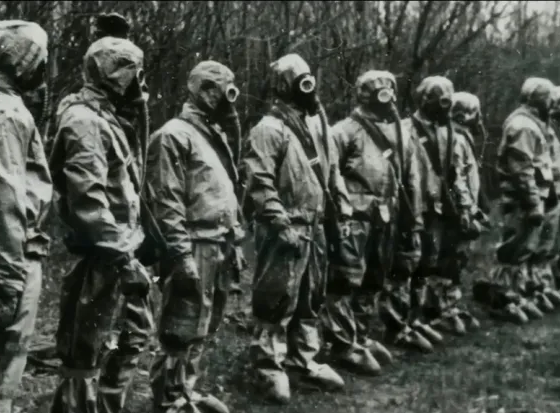
The 1986 Chornobyl explosion sent radiation across Europe and prompted Soviet authorities to mobilise vast numbers of men and equipment to deal with the accident.
It is now protected by a vast multi-layered system.
At its heart is the original concrete sarcophagus built after the 1986 explosion to contain radioactive material.
Surrounding that is the New Safe Confinement—an enormous steel dome completed in 2016 and stretching 100 metres high.
It was designed as a dual-skin steel shield that arches over the original 1986 sarcophagus to further seal off radiation and allow safe dismantling of the reactor beneath.
It also acts as a containment zone to trap radioactive dust using negative pressure and a sealed membrane.
But that outer arch was never built to withstand the force of a brutal Russian attack.
Artem Siryi, a Ukrainian Government official who manages Chernobyl’s fragile protective cover, told The Sun: “This project was never designed to deal with a direct military strike. We had to invent solutions on the fly.”
According to Siryi, the drone directly hit the outer metal cladding over the structure’s central crane maintenance garage, blasting a 15-square-metre hole.
The remains of the drone, including its engine, penetrated the second, inner layer and landed inside the garage.
That initial impact sparked a hidden inferno within the arch’s “layered cake” of materials — metal cladding, Rockwool insulation, and a crucial 1.5mm sealing membrane.
“When the fire started smouldering under the insulation, it was almost impossible to detect from the outside,” Siryi said.
“We had to use drones with thermal imaging to find the fire hidden inside the layers.”
To stop the flames from spreading beneath the outer shell, firefighters were forced to cut dozens of small access hatches — about 30 by 30cm — into the dome, pouring water into the insulation from above.
But temperatures plunged to minus 16°C, freezing the water and blocking access paths, forcing responders to drill even more holes.
“It was a nightmare,” Siryi said.
He added: “We were very lucky that the strike did not hit the concrete shelter structure that holds the radiation in.
“If it had landed in a different spot, it could’ve compromised the concrete sarcophagus enveloping the reactor. Then we’d be dealing with a very different situation.”
But the expert warned that a second drone strike could be enough to bring the dome down and trigger a full-scale radiation leak if the structure is not repaired as soon as possible.
“If another drone hits, it could collapse part of the structure,” he said.
“That would mean radioactive dust, with particles of nuclear fuel from Unit 4, escaping into the environment.”
Russia occupied the Chernobyl plant and the surrounding area for more than a month in the first weeks of its February 2022 invasion of Ukraine as its forces initially tried to advance on the Ukrainian capital Kyiv.
What happened at Chernobyl?
WHEN an alarm bellowed out at the nuclear plant on April 26, 1986, workers looked on in horror as the control panels signaled a major meltdown in the number four reactor.
The safety switches had been switched off in the early hours to test the turbine but the reactor overheated and generated a blast – the equivalent of 500 nuclear bombs.
The reactor’s roof was blown off and a plume of radioactive material was blasted into the atmosphere.
As air was sucked into the shattered reactor, it ignited flammable carbon monoxide gas causing a fire which burned for nine days.
The catastrophe released at least 100 times more radiation than the atom bombs dropped on Nagasaki and Hiroshima.
Soviet authorities waited 24 hours before evacuating the nearby town of Pripyat – giving the 50,000 residents just three hours to leave their homes.
After the accident traces of radioactive deposits were found in Belarus where poisonous rain damaged plants and caused animal mutations.
But the devastating impact was also felt in Scandinavia, Switzerland, Greece, Italy, France and the UK.
An 18-mile radius known as the “Exclusion Zone” was set up around the reactor following the disaster.
Most recently, on February 24, 2022 during the Russian invasion, Ukraine lost control over the Chernobyl site.
An adviser to the Ukrainian President, Mykhailo Poldoliak, told reporters: “After a fierce battle, our control over the Chernobyl site was lost.
“The condition of the former Chernobyl nuclear power plant, confinement, and nuclear waste storage facilities is unknown.”
That same day Russian troops descended upon Chernobyl, capturing the area rapidly and killing those who stood in their way.
Ukrainian President Volodymyr Zelensky tweeted that day in response to the events, “Russian occupation forces are trying to seize the Chernobyl [Nuclear Power Plant]. Our defenders are sacrificing their lives so that the tragedy of 1986 will not be repeated.
“This is a declaration of war against the whole of Europe.”
Anton Herashchenko, an adviser to the interior minister, told The New York Times that Ukrainian troops had put up a “fierce resistance,” but warned, “radioactive dust could cover the territory of Ukraine, Belarus and the countries of the European Union.”