

A few days ago, the world woke up to the news of an alleged “peace plan” for Ukraine, negotiated between Washington and Moscow and presented to Kiev as a fait accompli. A document with 28 points, now reduced to 19, but which does not resolve the essentials: who guarantees the security of Ukrainians, what future will Kiev be allowed and, fundamentally, what will happen to the territories illegally occupied by Russia?
Translated to a scale we can understand: currently the regions that Russia controls or claims represent about 20% of Ukraine. It would be like wanting to impose on the Portuguese that we cede the North coast and part of the Center to end a war. None of us would accept such a thing. Why should Ukrainians accept it?
The historical analogy is inevitable. In 1938, in Munich, in the name of “peace”, Czechoslovakia was forced to cede the Sudetenland. What they saw as a compromise was, in fact, a tragic mistake: it legitimized the aggression, emboldened the aggressor and paved the way for a much more devastating conflict. The pattern repeats itself. In 1994, Kiev agreed to dismantle its nuclear arsenal in exchange for security guarantees from Russia. Russia violated them in 2014, with the annexation of Crimea, and in 2022, with the large-scale invasion. Today, the victim is asked to pay the bill for successive violations of international law.
A poorly designed truce will have consequences that go far beyond Ukraine. It would allow Russia to regain strength, while Ukraine faces human and economic wear and tear. It would send a clear signal to all revisionist powers: it pays to use force, as long as one has the patience to wait for the opponent’s fatigue. Beijing would be attentive to the Taiwan issue. Others, in other regions, too.
There is, however, another problem, equally serious: the EU’s virtual absence from this process. Borders on the European continent are discussed, the future of Ukraine’s membership of the Union and NATO, the fate of Russian assets frozen on European territory and the EU appears, at best, as a backdrop, not as a full partner.
A peace built on the margins of Europe will always be a fragile peace and, probably, an unjust peace. Defending Ukraine is not a moral whim: it is a matter of European security. If today we accept that the borders are being changed by force in Kiev, what guarantees do we have that the same thing will not be attempted closer to us? There was a time when colonial powers redrew maps from a distance, ignoring the will of the people. This time should be over. Ukraine’s borders cannot be decided according to Putin’s political expediency or Trump’s commercial calculations.
Ukraine is not just a test of Ukrainians’ courage. It is a test of our own courage, our historical memory and our ability to learn from past mistakes. If we fail now, it will not be just Ukraine that pays the price. It will be all of Europe.
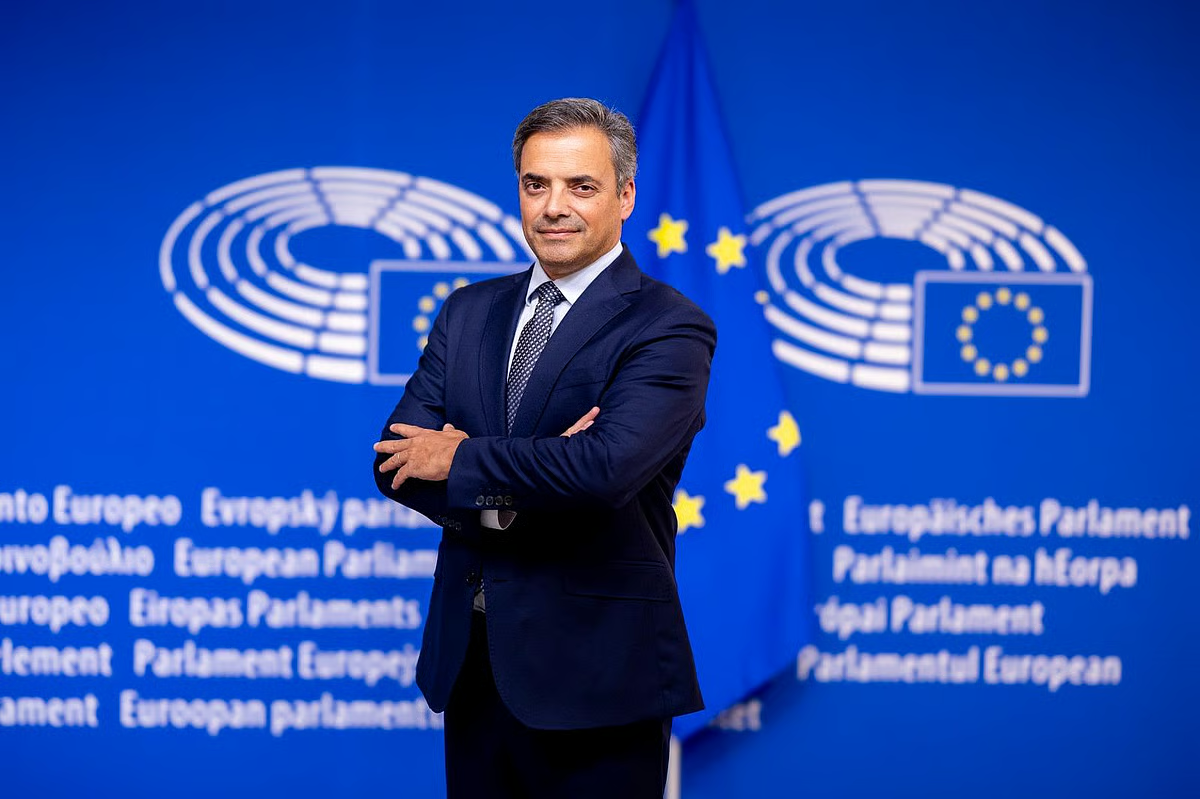
MEP and Member of the Defense Committee of the European Parliament. Attorney.