
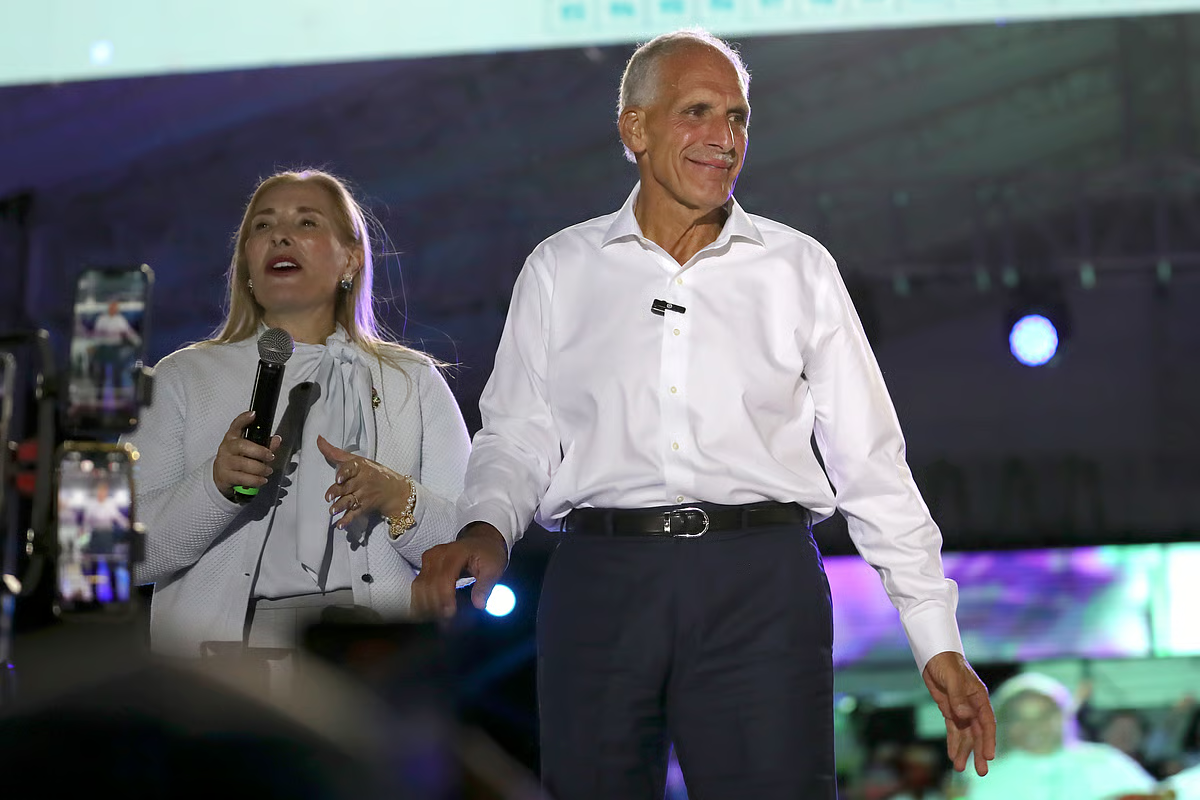

Conservative presidential candidate Nasry Asfura — supported by United States (US) President Donald Trump — leads the initial vote count in the general elections held in Honduras, according to preliminary results.
According to the Honduran National Electoral Council (CNE), more than four hours after the polls closed on Sunday, and with 34.25% of the votes counted, Asfura, from the National Party, had won 530,073 votes, or 40.6% of the total.
In a statement broadcast on Honduran national television, members of the CNE said that another right-wing candidate, television star Salvador Nasralla of the Liberal Party, was in second place with 506,316 votes, 1.8 percentage points less than Asfura.
Far behind, 21 percentage points away, was the left-wing presidential candidate, Rixi Moncada, supported by the party currently in power in Honduras.
The president of the CNE, Ana Paola Hall, highlighted the “civic spirit” demonstrated during the elections and ordered the polling stations to remain in their locations until the counting and transmission of all tabulation minutes for the different levels of voting were completed “in a transparent manner”.
On Saturday, Rixi Moncada accused the US Administration of “acts of interference” in the election process.
“There is no doubt that there were two actions, three days before the elections, that are totally interventionist”, said the candidate.
Moncada made reference to Trump’s announcement that he will grant a pardon to former Honduran president Juan Orlando Hernandez, claiming that, “according to many people” whom he respects immensely, Hernandez was “treated very harshly and unfairly.”
Hernandez was sentenced in 2024 to 45 years in prison for drug trafficking and weapons-related crimes.
Trump also expressed support for businessman Nasry Asfura.
If Asfura loses Sunday’s election, Trump said, “the United States will not waste money, because a wrong leader can only bring catastrophic results to a country.”
Around 6.5 million Honduran voters were called to the polls on Sunday to choose between the continuity of a left-wing government and the return of the right, in an atmosphere of high political tension and violence.
In a country ravaged by poverty, corruption and violence, voters in Honduras will elect the next President, but also the 128 members of parliament and hundreds of mayors, among other positions, for the next four years.
The other two candidates, with no prospects of achieving victory, according to the polls, are Nelson Ávila Gutiérrez, from the Innovation and Social Democratic Unity party (PINU – center-left) and Mario Rivera Calejas, from the Christian Democratic Party (DC – center-right).