
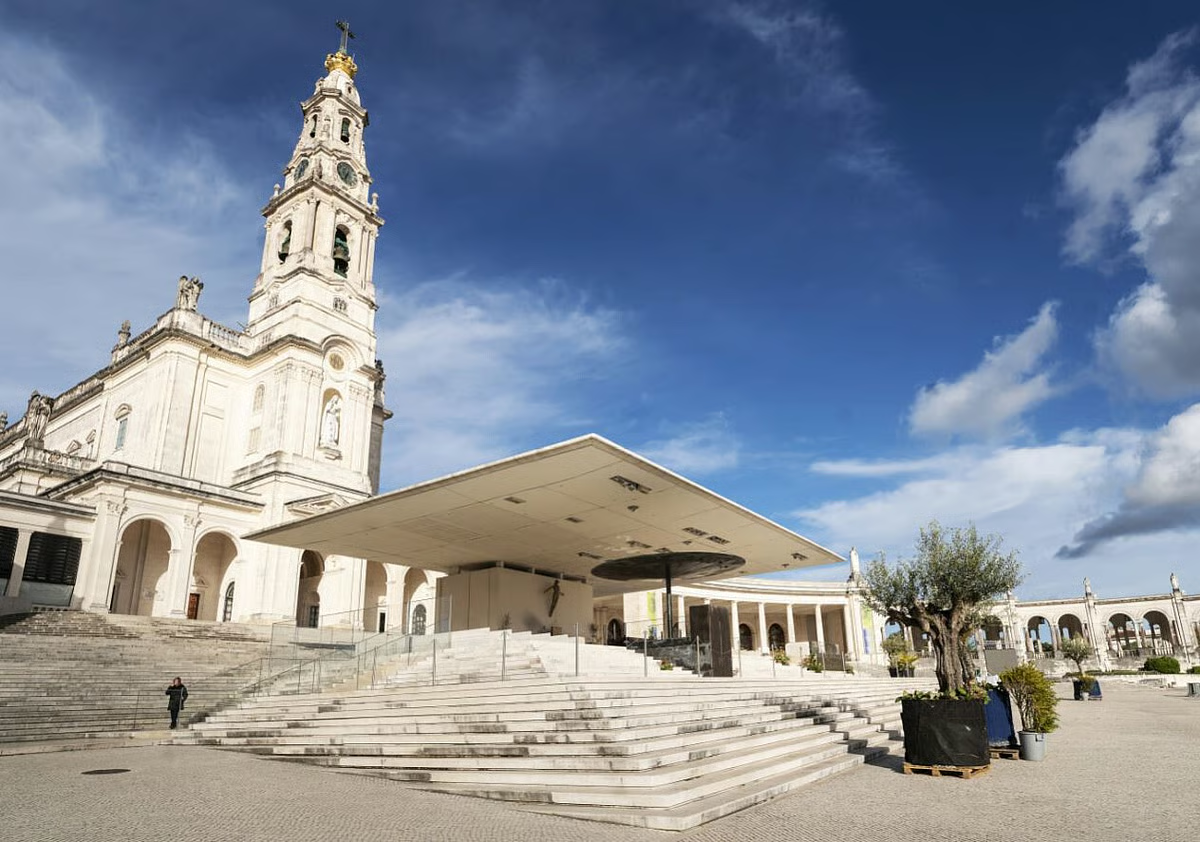

The Sanctuary of Fátima opens on Saturday, November 29, an exhibition with objects belonging to Sister Lúcia that have never been shown to the public and works classified as National Treasure, to mark the centenary of the Virgin’s apparitions to the seer, in Pontevedra, Spain.
A habit, letters, a crucifix, pens and a castanet are among the objects, as well as crafting accessories (thimble, needle or ball of yarn), and an altar, liturgical implements and ecclesiastical vestments, all made in miniature by the seer.
The exhibition, entitled “Refúgio e Caminho”, includes the paintings “Ecce Homo”, from the National Museum of Ancient Art (Lisbon), and “Última Supper”, from the Frei Manuel do Cenáculo National Museum (Évora), both National Treasures.
In terms of works of art, the sanctuary highlights the representation of the apparition of Pontevedra by Matilde Olivera, the sculptures by Thomas McGlynn created based on Lúcia’s descriptions, the tapestry by Jenny de Beausacq, the Way of the Cross by Joaquim Correia and contemporary works by artists such as Sílvia Patrício, Russell West, João Porfírio and Inês do Carmo.
Lúcia de Jesus (Fátima, 1907 – Coimbra, 2005), after the death of her cousins, the saints Francisco and Jacinta Marto, entered the Institute of the Sisters of Santa Doroteia, in 1925, where she remained until 1948.
Her journey as a religious Doroteia, in which she took the name Maria das Dores, was mostly lived in Spain, where she had the two apparitions that complete the cycle of the message of Fátimawith requests for the devotion of the five first Saturdays (1925), in Pontevedra, and the Consecration of Russia to the Immaculate Heart of Mary (1929), in Tui, Spain.
The visionary entered the Carmelo de Santa Teresa, in Coimbra, in March 1948, where she remained until her death.
“Lúcia is a figure with a power of attraction like few figures in the 20th century Church had and, sometimes, we, in Portugal, forget that”, said the director of the Museum of the Sanctuary of Fátima and general coordinator of the exhibition, Marco Daniel Duarte, to emphasize that the seer’s biography is of interest to the History of Fátima, the Church, the country and the world.
The exhibition is part of a four-year program, divided into two cycles, the first of which, with this exhibition, marks the centenary of the Pontevedra apparitions, and the second the centenary of the Tui apparitions.
Divided into seven sections, it begins with the symbol of the “Heart of Mary, as Sister Lúcia defines it based on the visions she had”, and the expression “Refuge and Path”, taken from the documentation relating to the events of 1917, in Cova da Iria.
At the beginning of the exhibition path, “guided” by sister Lúcia and her “mystical experience”, a large life buoy appears, full of roses, and shaped like a heart, flanked by images of the candle procession and the goodbye procession.
“In the world we live in, when we see a heart in the shape of a buoy, a lifeline, it brings to mind the difficult places to live, the issue of refugees and all the places in the world where the Heart of Mary can be a lifeline and salvation”, he observed.
In one of the rooms, there are the 14 Stations of the Cross that “frame” a heart studded with thorns, to emphasize that, “even in the hardships of life, it does not lose its heart shape”, in a space with projection of images in the context of war, but where there are “signs of hope”, he said.
For Marco Daniel Duarte, the “most touching” document in the exhibition is a “letter that Lúcia writes” to her mother, asking her to start doing the devotion of the first five Saturdays.
Among other aspects, the exhibition includes a section dedicated to the representation of the “Heart of Mary”, which after the events of Fátima is presented with thorns instead of having flowers around it, and it is with the Immaculate Heart of Mary that the exhibition ends.
“In the language of Fatima, the Heart of Mary triumphs (…), always with the prayer of the Rosary for peace in the world and always pointing to Christ”.
The general coordinator highlighted that the exhibition allows for a sensorial experience, with a screen where sins are eliminated for recycling and a structure to leave thorns, along the way for which a musical theme was created that “will always have a heartbeat”.
“The great key to reading here is this: victory is always that of good over evil. This is the refrain of Fátima.”
The exhibition, on the lower floor of the Basilica of the Holy Trinity, opens on Saturday and will be open until October 15, 2027, with free entry.