
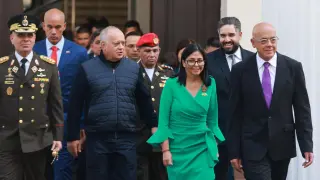

The “Donroe Doctrine” is the 21st century version of an old imperial reflex: Trump has made it a manifesto of dominion over the Western Hemisphere, an ambition that its operation in Venezuela has made explicit.
At its core, the “Donroe doctrine” is an update of an idea, that of control in an area that Washington considers its natural sphere of influence, where others only enter with permission.
And while the Monroe Doctrine was presented as a warning to the European powers not to open new colonies in AmericaTrump’s version calls for something more extreme: that no external power can deploy forces, control key resources or decide the political direction of the region without the approval of the United States.
This same Tuesday, Trump showed his cards within that strategy and aimed high, predicting for Greenland a future similar to that of Venezuela: his Administration is studying “various options” to take control of the ice island and that includes “the use of the US Armed Forces,” according to the White House.
He insists that the US “needs Greenland for reasons of national security.” Because, in his scheme, taking over Greenland allows him to close the strategic encirclement of the hemisphere, controlling Arctic routes, resources and military positions against Russia and China.
European leaders have positioned themselves against this movement. To the point that the president of Greenland, Jens-Frederik Nielsen, thanked the declaration signed by leaders of six European countries in defense of the sovereignty of this Danish autonomous territory.
The declaration – which includes, apart from Denmark, the leaders of the governments of Spain, France, Germany, Italy, the United Kingdom and Poland – highlights that Greenland “belongs to its people” and that only Denmark and Greenland can “decide” on matters that concern both territories.
On the other hand, the key to Trump’s approach to dominance was displayed during his press conference in Washington, reinforcing the idea that the Venezuelan future will go through a “reconstruction” led by Washington before any election.
No opposition
The new National Security Strategy puts that ambition in writing with unusual clarity:: The United States “will reaffirm and implement the Monroe Doctrine to restore American supremacy in the Western Hemisphere” and “will deny non-hemispheric competitors the ability to position forces or control strategic assets in our hemisphere.” That is to say: neither Chinese, nor Russians, nor Iranians, nor anyone who does not pass through Washington. This is what emerges from Trump’s corollary to the Monroe doctrine.
Venezuela has been the perfect showcase. After the operation that takes Maduro out of bed and leaves him in a Brooklyn federal prison in less than 24 hours, Trump stood before the press: “Under our new national security strategy, American dominance in the Western Hemisphere will never be questioned again. It’s not going to happen“.
.@SecRubio “This is our hemisphere, and President Trump will not allow our security to be threatened.”
The Secretary of State, Marco Rubio, participated in several news programs to address the decisive operation of the Trump Administration that achieved the capture of… https://t.co/GYtJgyt2PP
— US Embassy (@laembajada) January 5, 2026
The White House amplified it in X with a message that smacked of doctrine in 14 words: “This is our hemisphere and President Trump will not allow our security to be threatened“.
Secretary of State Marco Rubio hammered it home further: “This is the Western Hemisphere. This is where we live, and we are not going to allow it to be a base of operations for adversaries, competitors and rivals of the United States.” And Pentagon chief Pete Hegseth gave troops a slogan worth wearing on a T-shirt: the Monroe is “back and in full effect”and they are the new generation that enforces it on the ground.
FAFO and the new “backyard”
In the Monroe Doctrine, what was later called “backyard” was a way of referring to Latin America and the Caribbean like the back of the United States house: a space where Washington assumed the right to command and stop the entry of other powers. Over the years, that expression became popular to criticize how that vision served as alibi for interventions, coups and regime changes promoted by the US in the region.
In 1823, James Monroe drew the famous line of “America for Americans”which in practice meant “Europe, outside our hemisphere” and gave carte blanche to more than a century of Washington interventions in Cuba, Nicaragua and Haiti. Two centuries later, Trump boasts of having “far surpassed” that doctrine and renamed it “Donroe”, a ‘portmanteau’ between his last name and that of the former president who invented the concept of the “backyard.” This was clear in the words of the US president at the press conference after the operation against Maduro, in Mar-a-Lago.
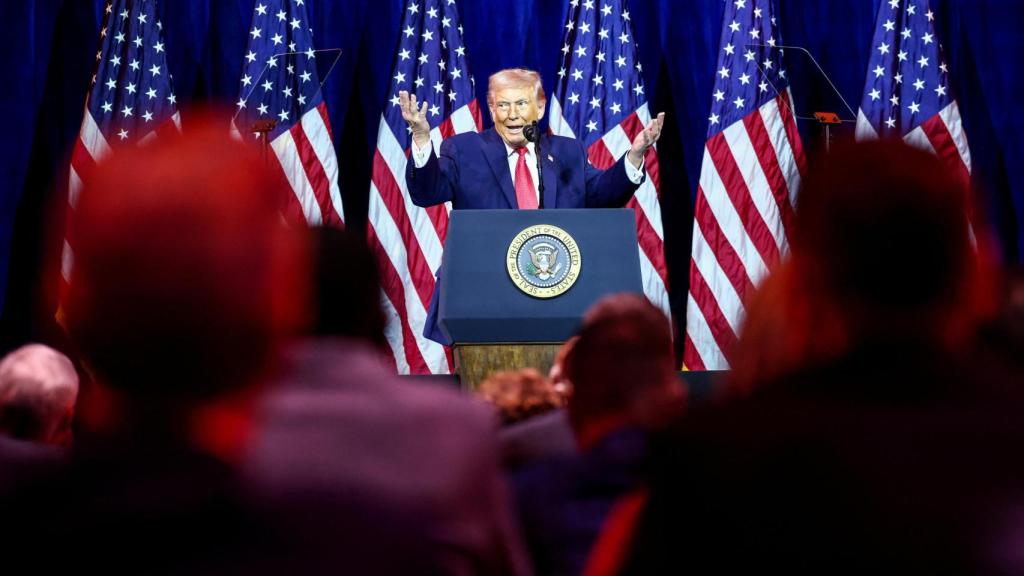
Trump during his speech at the renowned Trump-Kennedy Center.
Reuters
Maduro’s capture is also an internal nod against the fame that Trump always chickens out at the last minutethe TACO theory (“Trump always chickens out”, or “Trump always chickens out”). This time, the White House has chosen another Anglo-Saxon acronym as a letter of introduction to the neighborhood: FAFO, “fuck around and find out” or “keep fucking and you’ll see,” in the words of Hegseth himself hours after the operation.
With that surgical blow, the “Donroe doctrine” goes from PowerPoint to practice: if you are an uncomfortable leader in the neighborhood and you rely on drugs, cartels or extrahemispheric powers, the message is that you can end up the next night on a plane to the United States. And FAFO becomes the MAGA (Make America Great Again), Make America Great Again version of Theodore Roosevelt’s old “big stick,” but with more memes and less diplomacy.
Oil, China and democracy
Officially, it all started with cocaine and violations of sovereignty: Washington accused Maduro of drug trafficking and letting China, Russia and Iran put their hands too much in the largest oil deposit in the world.
Trump sold it as a crusade for the principles of American foreign policy “that go back more than two centuries,” but when it came to talking about the future what it promised was that American companies will be able to arrive, invest and “make money” in a country that the United States will be in charge of “governing” until a “safe and appropriate” transition.
Nicolas Maduro had his chance — until he didn’t.
The Trump Admin will always defend American citizens against all threats, foreign and domestic. 🇺🇸🦅 pic.twitter.com/eov3GbBXf4
— The White House (@WhiteHouse) January 4, 2026
Furthermore, his administration has made it clear that in Caracas stability weighs more than the democratic epic: he has disdained opposition figures such as María Corina Machado or Edmundo González Urrutia and is testing a transition piloted by Delcy Rodríguez and the Chavista apparatus, as long as it guarantees internal order and total collaboration in migration and security.
It is the exported Bukele recipe: a tough hand against crime and open doors for mass deportations, although democratic standards remain in storage.
Who is “next”
The debut of the Donroe Doctrine does not stay in Caracas. Trump has already pointed out Colombia (“it could face a fate similar to that of Venezuela”), has said that Cuba is “ready to fall” and has left open the option of operations in Mexico under the banner of the fight against cartels.
In parallel, he has put his old obsession with Greenland back on the table—”we need Greenland from the point of view of national security”—which has led the Danish Prime Minister to warn that an attack against a NATO country “changes everything.”
This geographical expansion explains why many Europeans read the Donroe not only as a return to the Monroe, but as a possible threat to Western security architecture: If Washington gets used to violating sovereignties in its hemisphere without looking too closely at international law, Moscow and Beijing can interpret that the global board is once again governed by the logic of great powers in exchange for territories and resources.
And in that game, from Ukraine to Taiwan, the message that comes out of Caracas is that the United States is willing to make its move first and ask for permission (or forgiveness) later.
Decisive midterms
Taking advantage of the ‘momentum’, Trump has also tried to tie his personal fate to that of his party, warning congressmen that, if the Republicans lose the 2026 legislative electionsDemocrats will “find a reason” to impeach him again. Turning the midterms into a plebiscite on his leadership serves to discipline your own in Congress while defending its most aggressive foreign agenda.
In parallel, it has presentedor those elections as the retaining wall against an eventual turn in foreign policy if the opposition were to control the House again, suggesting that a Republican defeat could undo their bid for dominance of the Western Hemisphere. Thus, the 2026 polls would not only decide the distribution of seats in Washington, but also the continuity of the “Trump corollary” to the Monroe doctrine.